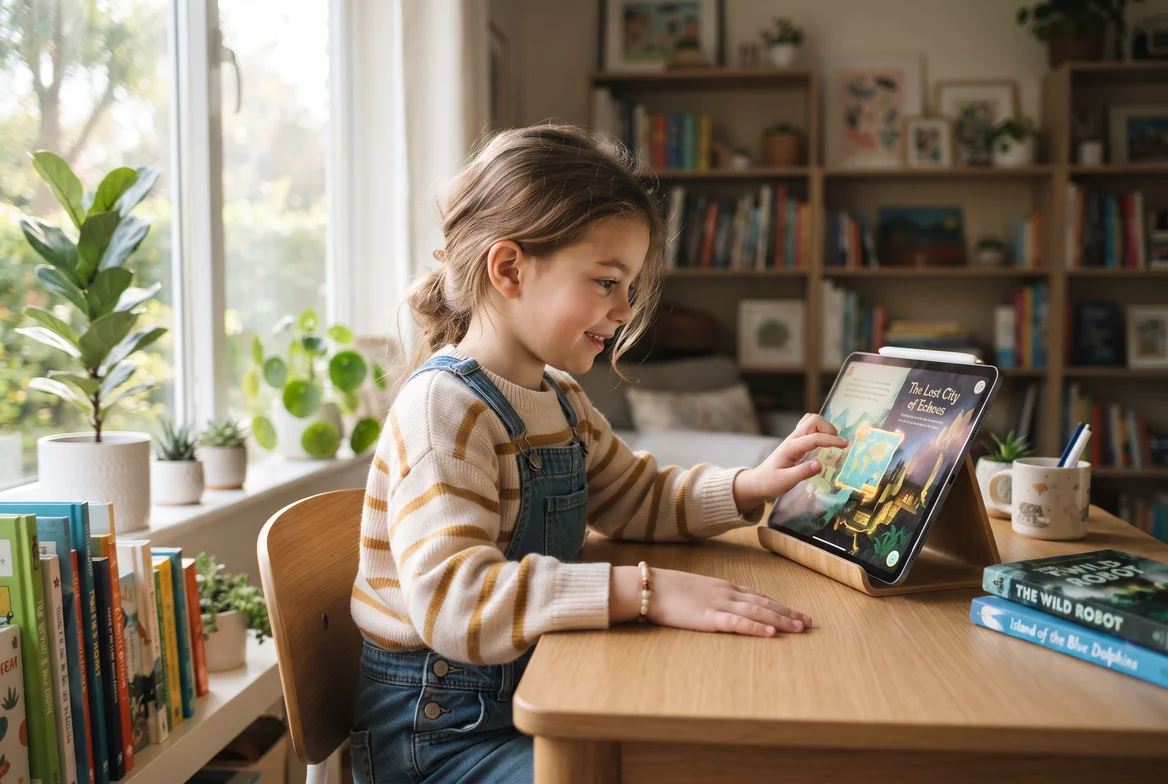
Short answer: When you worry about screen addiction, banning screens completely doesn’t last in most homes; a more workable path is replacing some passive video time with active reading. We offer free 2-5 minute illustrated books with narration for ages 4-9: your child turns the pages, and when the book ends, the screen stops. You can also download any book as a PDF and read it screen-free.
This article doesn’t treat screens as the enemy. Its aim is to change what happens during screen time and fit that change into your family’s routine over four weeks. For privacy and safety settings when kids read online, see our separate guide to free and safe digital children’s books.
10 Books to Swap in for a Video
| Book | Age | Level | Pages | Time |
|---|---|---|---|---|
| The Secret Path in the Park | 4-6 | A2.1 | 12 | 2 min 0 sec |
| The Kites’ Song | 4-6 | A2.1 | 12 | 2 min 6 sec |
| The Little Bird’s First Flight | 4-6 | A2.1 | 12 | 2 min 8 sec |
| Little Seal Bubbles and the Hourglasses | 4-6 | A2.1 | 10 | 2 min 19 sec |
| Barnaby the Little Bear and the Forest’s Tiny Postman | 4-6 | A2.1 | 12 | 3 min 8 sec |
| The Secret of the Lighthouse | 7-9 | A2.2 | 10 | 2 min 42 sec |
| Leo and the Old Phone Booth in the Forest | 7-9 | A2.2 | 10 | 2 min 53 sec |
| The Little Astronaut in the Moonlight | 7-9 | A2.2 | 15 | 3 min 2 sec |
| The Mysterious Village by Bicycle | 7-9 | A2.2 | 15 | 3 min 6 sec |
| Lily and the Little Robot’s Big Question | 7-9 | A2.2 | 12 | 3 min 32 sec |
Concrete Differences Between Watching and Reading
Same tablet, same minutes, but what your child is doing can be very different. Four questions help you tell them apart:
- Who moves it forward? Video plays on its own. In the online flipbook, your child turns to the next page; they can pause, go back, or stare at a picture for as long as they like.
- Is there an ending? In short-video apps, one clip ends and the next one starts. The last page of a book is a real ending, and it naturally opens the question “What should we do now?”
- How fast is it? Fast-cut videos keep re-grabbing attention. In a picture book, a scene stays on screen until your child is done looking.
- Is there something to talk about afterward? A story has a hero, a problem, and an ending, so it can come up again at dinner.
These differences don’t make digital reading “harmless”; they just fill screen time with something better. On total time, the World Health Organization’s 2019 guidelines advise no sedentary screen time under age 2 and no more than one hour a day for ages 2-4. For older children, the real test is whether screens are crowding out sleep, movement, and face-to-face play. If you want a structured way to set family rules, the American Academy of Pediatrics offers a free Family Media Plan tool on its HealthyChildren.org site.
The Swap Strategy: Which Video, Which Book?
What works best is not cutting screens off overnight but choosing one specific video slot and putting one specific book in its place.
| Current habit | Swap it for | Why it works |
|---|---|---|
| Cartoons at breakfast | One narrated book, then the tablet goes off | The book ends in 2-3 minutes; the stopping point is built in |
| Videos in the car or waiting room | A PDF printed ahead, or a book in the app | Your child turns the pages |
| Short videos after dinner | One book with siblings, then two questions | Screen time becomes a social moment |
| Tablet before bed | A printed book in dim light | No screen light right before sleep |
Make the transition easier: Give a five-minute warning before the end. For ages 4-6, an hourglass works wonders; the sand, not you, says when it’s over. Reading Little Seal Bubbles and the Hourglasses before you start this routine makes the hourglass part of the game.
Give your child control, but narrow the choices: Instead of “Tablet or book?”, ask “Shall we read the postman bear or the kites?” Two options give your child a sense of control, and either way, the answer is reading.
Use narration well: For ages 4-6, listen together and ask your child to point out one thing on each page. For ages 7-9, they can listen first, then turn the sound off and read the same book alone. If they stall on five or more words on one page, the book is too hard for now; choose one from the younger age group.
Step from the book into real life: Many books on this list take place outdoors. A trip to the park after The Secret Path in the Park, or a short bike ride after The Mysterious Village by Bicycle, turns the end of screen time into something to look forward to.
A 4-Week Transition Plan
| Week | Goal | Books | Screen-free step |
|---|---|---|---|
| 1 | Replace one video slot a day with a book | Little Seal Bubbles and the Hourglasses, The Kites’ Song | An hourglass “it’s over” game |
| 2 | Your child turns the pages | Barnaby the Little Bear and the Forest’s Tiny Postman, The Secret of the Lighthouse | Print one page from the coloring books section |
| 3 | Make bedtime fully screen-free | The Little Bird’s First Flight, The Little Astronaut in the Moonlight (printed PDF) | Read on paper before lights out |
| 4 | Go outside after the book | The Secret Path in the Park, The Mysterious Village by Bicycle | A park visit or a bike ride |
Mark every screen-free or book-swapped day on the reading log. After four weeks, looking back at the log shows which time slots were easy to change and which were hard, which practically writes next month’s plan for you.
Download the PDF and Read Screen-Free
- Open any book page from the table.
- Click Download PDF.
- Print on A4 or letter paper at full-page size and staple the pages.
After reading, printing a page from the coloring books section fills the first 15 minutes after the tablet goes off. All free files are in the free PDF children’s books library. If you prefer reading on a phone, the same books are in our app; use it with the same time rules.
Questions to Ask After Reading
- Little Seal Bubbles and the Hourglasses: Bubbles learned how time trickles away in an hourglass. How long do you think an hourglass lasts? Shall we test one?
- Barnaby the Little Bear and the Forest’s Tiny Postman: Barnaby crossed a wooden bridge to deliver a lost invitation to Lily the rabbit. Why does it matter to be a postman others can count on?
- The Kites’ Song: How did Can and his friends discover the joy of sharing while flying their kites? What did you share most recently?
- The Secret of the Lighthouse: How did solving the mystery of the old key help the three friends’ town?
- The Secret Path in the Park: What happened when Aras found the secret path? Is there a corner of our park we haven’t explored yet?
Related Guides
For e-book basics, see e-books for kids: online digital children’s books. All books by age are on the ages 4-6 and ages 7-9 pages.








