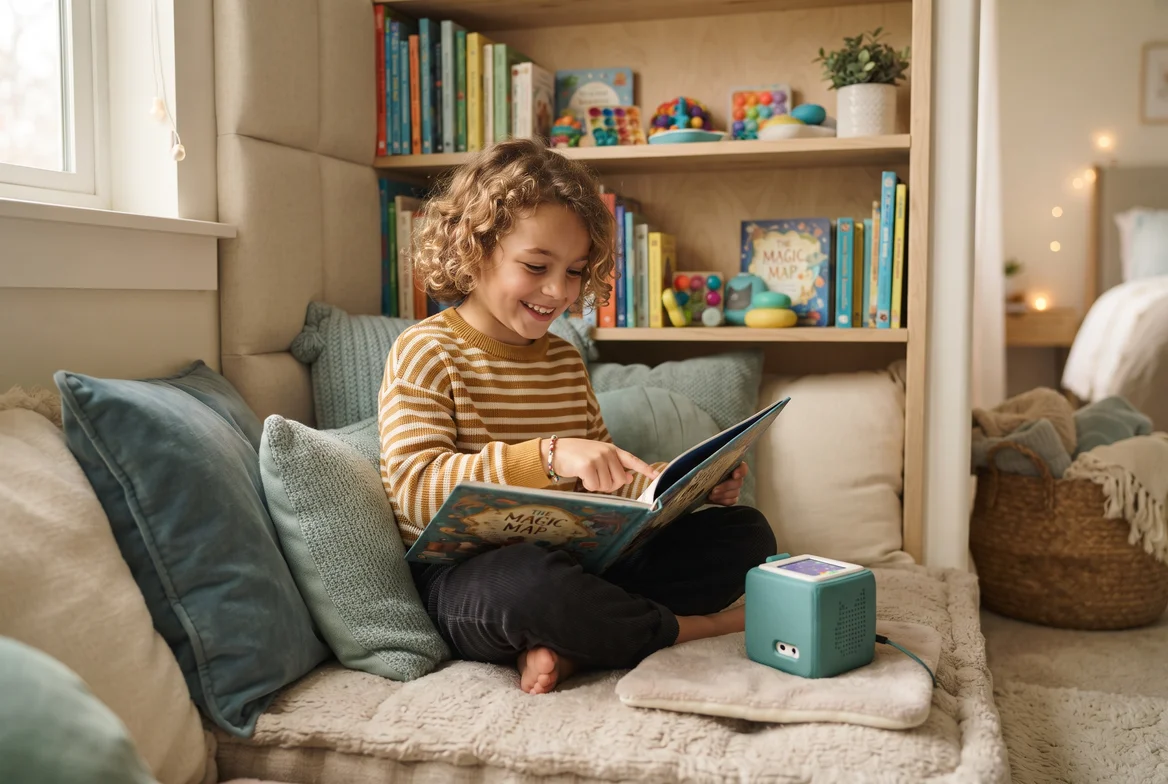
Short answer: For children with dyslexia and ADHD, or who simply find reading hard, we have 10-15 page stories with a large picture and only a little text on every page, and narration that runs about 1.5 to 4.5 minutes. Every book can be read online, listened to, or downloaded as a free PDF and printed.
An important note first: this article is not medical or educational advice, and it doesn’t offer a diagnosis or treatment. Audio and picture books do not treat dyslexia or ADHD. Our goal is to share practical ways to make reading at home less tiring and more enjoyable, alongside whatever support professionals recommend. For your child’s situation, please talk to their teacher, the school’s support team, your pediatrician, and, where needed, specialists such as a reading specialist, a speech-language pathologist, or a psychologist.
Why These Books Can Help
Dyslexia is generally understood as a learning difference that makes it harder to connect letters with sounds and decode words. ADHD can affect sustaining attention and managing impulses. Every child is different, but many families find these features make reading time easier:
- They’re short. A 2-3 minute story ends in one sitting, so your child feels “I finished it” before fatigue sets in.
- The pictures carry the story. A child who struggles to decode can follow the plot through the illustrations and stay inside the story.
- Narration models the words. Your child hears the correct pronunciation while following the text. Focusing on meaning is less draining than decoding every word alone.
- They’re easy to repeat. Reading the same short book several times feels reassuring, not boring, and each repeat adds more familiar words.
10 Short Stories to Start With
This list is chosen by reading load, not age: little text per page, familiar themes, and predictable plots. There’s nothing wrong with a school-age child reading books from the 4-6 age group; what matters is that the reading feels comfortable.
| Book | Age | Level | Pages | Time |
|---|---|---|---|---|
| Elara and the Little Bird | 7-9 | A2.1 | 10 | 1 min 34 sec |
| Ela the Swallow and Minik the Ant | 4-6 | A2.1 | 12 | 1 min 40 sec |
| HopHop the Sharing Rabbit | 4-6 | A2.1 | 10 | 1 min 54 sec |
| Can and His Flying Friend Pof | 4-6 | A2.1 | 10 | 1 min 59 sec |
| The Rabbit and the Tortoise | 4-6 | A2.1 | 12 | 2 min 0 sec |
| The Little Bird’s First Flight | 4-6 | A2.1 | 12 | 2 min 8 sec |
| Little Seal Bubbles and the Hourglasses | 4-6 | A2.1 | 10 | 2 min 19 sec |
| Phinney the Little Elephant and the Whisper Game | 4-6 | A2.1 | 12 | 2 min 43 sec |
| Merve’s School Bag Countdown | 7-9 | A2.2 | 12 | 3 min 34 sec |
| The Tiny Snail’s Path of Patience | 4-6 | A2.1 | 15 | 4 min 36 sec |
Practical Steps for Easier Reading Time at Home
These are general home suggestions; if your child’s teacher or specialist recommends a different approach, follow theirs first.
- Short and often: 5-10 minutes every day instead of one long weekly session. If your child wants another story, add one; if not, stop there.
- A calm corner: TV off, only the book on the table. If you use a tablet, turn notifications off.
- Pictures first: Before reading, flip through the pages together and look at the pictures: “What do you think is happening here?” That prediction makes the text easier to understand.
- Movement breaks: When attention drifts, offer a one-minute stand-up-and-stretch break instead of pushing through, then return to the same page.
- Comfortable level: If your child gets stuck on more than five words on a page (the five-finger rule), the book is too hard for now. Switch to a shorter one or use that book only for listening.
- Praise the effort: “You tried that hard word again” instead of “You read so fast.” Feedback about effort can help reduce reading anxiety.
Using Narration and the PDF Together
Reading the same book three different ways turns a short story into your child’s “own book”:
- Listen: Turn on narration in the online reader. Your child just listens and looks at the pictures.
- Listen and track: The next day, they listen again while following each line with a finger.
- Read on paper: Print the PDF. Your child uses a ruler or index card under the line to focus on one line at a time and colors in the words they know.
The paper version also suits families who want to avoid the extra stimulation a screen can bring.
A Gentle 4-Week Start
One short story a day, no more than 10 minutes. Weekends are free: let your child pick a favorite from that week and listen again.
| Week | Books | Focus |
|---|---|---|
| 1 | HopHop the Sharing Rabbit, Can and His Flying Friend Pof, Elara and the Little Bird | Listening only; guessing from the pictures |
| 2 | Ela the Swallow and Minik the Ant, Merve’s School Bag Countdown, The Rabbit and the Tortoise | Tracking with a finger while listening |
| 3 | The Little Bird’s First Flight, Little Seal Bubbles and the Hourglasses | Reading one page together |
| 4 | Phinney the Little Elephant and the Whisper Game, The Tiny Snail’s Path of Patience | Marking known words on the printed PDF |
Seeing progress is motivating. Record books on the printable reading log, and print the certificate when it’s full. With a free account, reading history and badges build up automatically.
How to Download the PDF
- Click a book title in the list.
- Press Download PDF on the book page.
- Print on A4 or letter paper.
For hands-on kids, each book’s illustrations can also be downloaded as coloring pages, and there are more in the coloring books section. Coloring the same characters after reading is a nice way to revisit the story. All free files are in the free PDF children’s books library.
Questions After Reading
Spoken answers are plenty. Your child can also answer with a drawing or by pointing to a page in the book.
- The Rabbit and the Tortoise: Why did the tortoise win the race? If you were the rabbit, what would you do differently?
- The Tiny Snail’s Path of Patience: Calm the snail moved slowly. What did he notice that his fast friends missed? Can you think of a time when slow was good?
- Phinney the Little Elephant and the Whisper Game: How did Phinney learn to change how loud his voice was? What do you do when you get excited?
- Little Seal Bubbles and the Hourglasses: What did the hourglass teach Bubbles about time? Shall we play a game at home with a timer?
- Merve’s School Bag Countdown: What did Merve pack in her bag? Shall we count what goes in your bag for tomorrow?
When to Talk to a Professional
Don’t wait to ask for help if your child’s reading is clearly behind their peers and has been for a while, if they avoid reading or school, if homework has become a constant source of tension, or if a teacher has shared a concern. Start with the classroom teacher and your pediatrician. In the US, you can also ask your child’s public school, in writing, for an evaluation to see whether they qualify for extra support; outside the US, ask the school which evaluation services are available locally.
Related Pages
Find more short stories on the ages 4-6 and ages 7-9 pages. For help choosing books by level, length, and illustrations, see how to choose a children’s story book.








