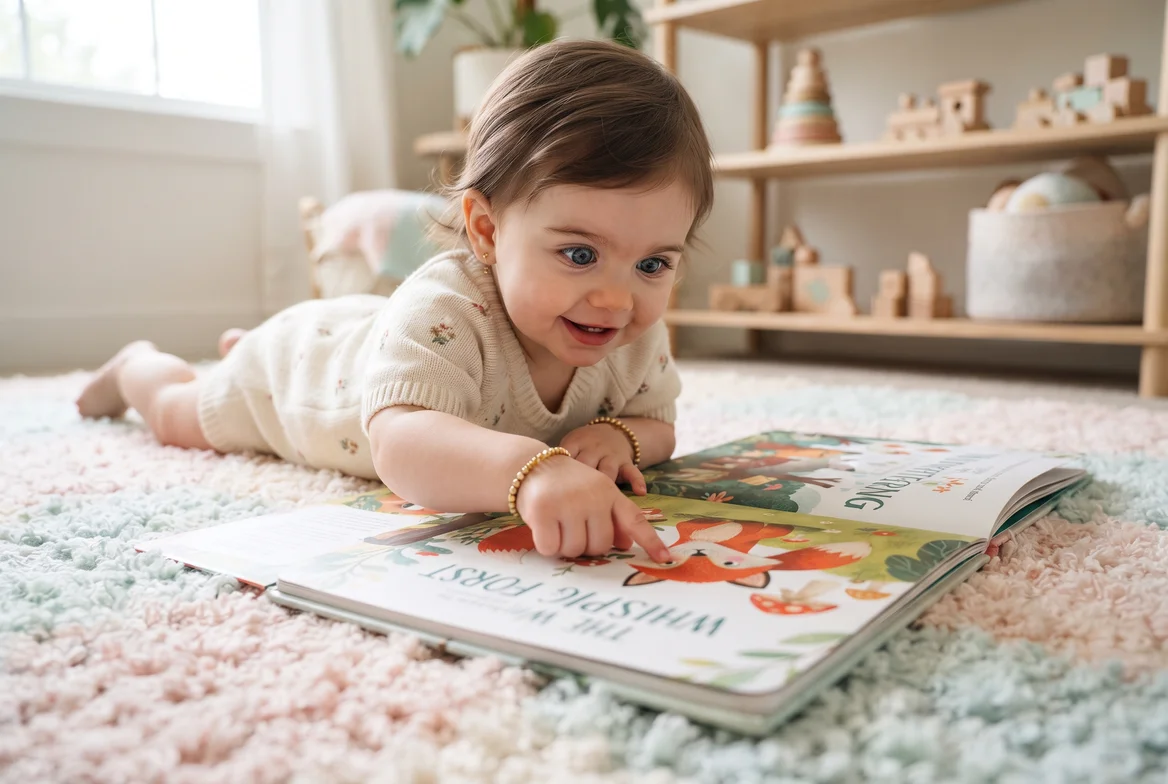
Picture books are the simplest way to build visual literacy and attention span together: your child looks closely, finds a detail, reads a character’s feelings from their face, and retells the story in their own words. The picture stories below are for ages 0–9, last about half a minute to three minutes, and can all be read online, heard with audio narration, or downloaded as a free PDF.
This post treats a picture book as two books in one: the words you read aloud, and the pictures your child “reads” separately. Below you’ll find titles that reward close looking, methods by age, a short-and-successful approach to focus, and a one-week plan.
10 Books That Reward Close Looking
Each one hides a looking game inside it: searching, comparing, sorting, or seeing from a new angle.
| Book | Age | Level | Pages | Time |
|---|---|---|---|---|
| Where is the Colorful Fish? | 0-3 | A1.1 | 12 | 33 sec |
| Where is the Little Kitten Hiding? | 0-3 | A1.1 | 12 | 1 min 5 sec |
| The Little Caterpillar’s Colorful World | 0-3 | A1.1 | 12 | 2 min 5 sec |
| The Secret Path in the Park | 4-6 | A2.1 | 12 | 2 min 0 sec |
| The Piper of Hamelin | 4-6 | A2.1 | 12 | 2 min 2 sec |
| The Color-Changing Bug | 4-6 | A2.1 | 12 | 2 min 22 sec |
| Pip the Little Bird and the Upside-Down World | 4-6 | A2.1 | 12 | 2 min 21 sec |
| Little Gigi the Giraffe and the Colorful Ribbons | 4-6 | A2.1 | 10 | 2 min 55 sec |
| Pip the Little Panda and the Smiling Flower | 4-6 | A2.1 | 12 | 2 min 58 sec |
| The Curious Girl’s Colorful Dream | 7-9 | A2.2 | 15 | 3 min 8 sec |
Visual Literacy in Four Small Skills
Breaking visual literacy into four skills makes it easy to practice. One question per skill is enough:
- Noticing: “What’s on this page? Can you find one more?” Search books like Where is the Colorful Fish? and Where is the Little Kitten Hiding? are made for this.
- Comparing and sorting: “Which one is longer? Can we line them up by color?” Little Gigi the Giraffe and the Colorful Ribbons builds this game right into the story, as Gigi and Phinney sort ribbons in more than one way.
- Reading feelings: “How do you think he feels right now? How can you tell?” In The Color-Changing Bug, Spot changes color with his moods, so your child links color to emotion.
- Changing perspective: “How would this look if you were a bird?” Pip the Little Bird and the Upside-Down World is about exactly that.
Reading the Pictures by Age
Ages 0–3: Choose pages with few objects and clear shapes. Instead of reading the text, point to an object, name it, and then let your child point. A book might last one minute or get repeated five times in a row. Both are normal.
Ages 4–6: Listen once with narration. On the second read, turn the sound off and have your child tell the story from the pictures alone. Notice the details they add rather than the pages they skip; that’s imagination at work.
Ages 7–9: As text gets longer, pictures act as a summary. Before reading a page, have your child look at the picture and predict what will happen, then read to check. Predicting and checking is the backbone of reading comprehension.
Grow Focus With Short Wins
Attention span grows through short, successful sessions, not through pushing. Start with a one-minute book and stop when your child finishes. The next day, try a two-minute book. By the end of the week, a child who sits through a three-minute story has focused longer than on day one, and felt good doing it. If they start to wiggle, close the book; an unfinished story leaves curiosity for tomorrow.
Let your child set the page-turning pace. In the online flipbook, having them turn the pages lets them decide when they’re ready to move on. Turning off the TV and leaving phones in another room is a small step that makes a real difference.
The Picture Detective Game
After the story, open the book to a random page and give your child ten seconds to study the picture. Then close it and ask: “How many animals were there? What color was the sky? What was the character holding?” Check the answers together. One or two questions are enough at first; add more as your child gets better, or switch roles and let them ask you the questions. The game quietly shows children the difference between looking at a picture and really seeing it.
A 7-Day Picture-Reading Plan
Five to ten minutes a day, ideally at the same time.
| Day | Book | Picture game |
|---|---|---|
| 1 | Where is the Colorful Fish? | Who can point to the fish first on each page? |
| 2 | Where is the Little Kitten Hiding? | Find Fluffy, then play hide-and-seek at home |
| 3 | Little Gigi the Giraffe and the Colorful Ribbons | Order the ribbons from long to short, then sort your crayons |
| 4 | The Color-Changing Bug | Which feeling does each of Spot’s colors show? |
| 5 | Pip the Little Bird and the Upside-Down World | Tilt your head to look at a picture. What changed? |
| 6 | Pip the Little Panda and the Smiling Flower | Find something outdoors that looks like a face |
| 7 | Your child’s pick | Sound off: your child tells the story from the pictures |
For babies, alternate Where is the Colorful Fish? and The Little Caterpillar’s Colorful World on days 1 and 2. An older sibling aged 7–9 can read The Curious Girl’s Colorful Dream the same week and describe the strangest picture in it.
How to Download the PDF
- Click a title in the table to open the book page.
- Press the PDF download button.
- Print in color on A4 or US Letter if you can.
On printed pages, your child can circle what they find. To meet the same characters again, print free pages from the coloring books section; coloring means studying a picture as its maker. All downloadable books are in the free PDF children’s books library.
Questions to Ask After Reading
- Pip the Little Bird and the Upside-Down World: What did the world look like when Pip hung upside down? What would you like to look at from a different angle?
- The Color-Changing Bug: What color did Spot turn when he was happy? When he was sad? What color are you today?
- Pip the Little Panda and the Smiling Flower: Why did the flower look like it was smiling? What was really inside?
- The Secret Path in the Park: How did Aras notice the secret path? Is there a spot in our park we’ve never really looked at?
Keep Exploring
See the ages 0–3 and ages 4–6 pages for more picture books. For creative reading ideas, read the most beautiful book stories that support creativity, and for the youngest readers, what to consider when choosing storybooks for 0-3 year olds.








