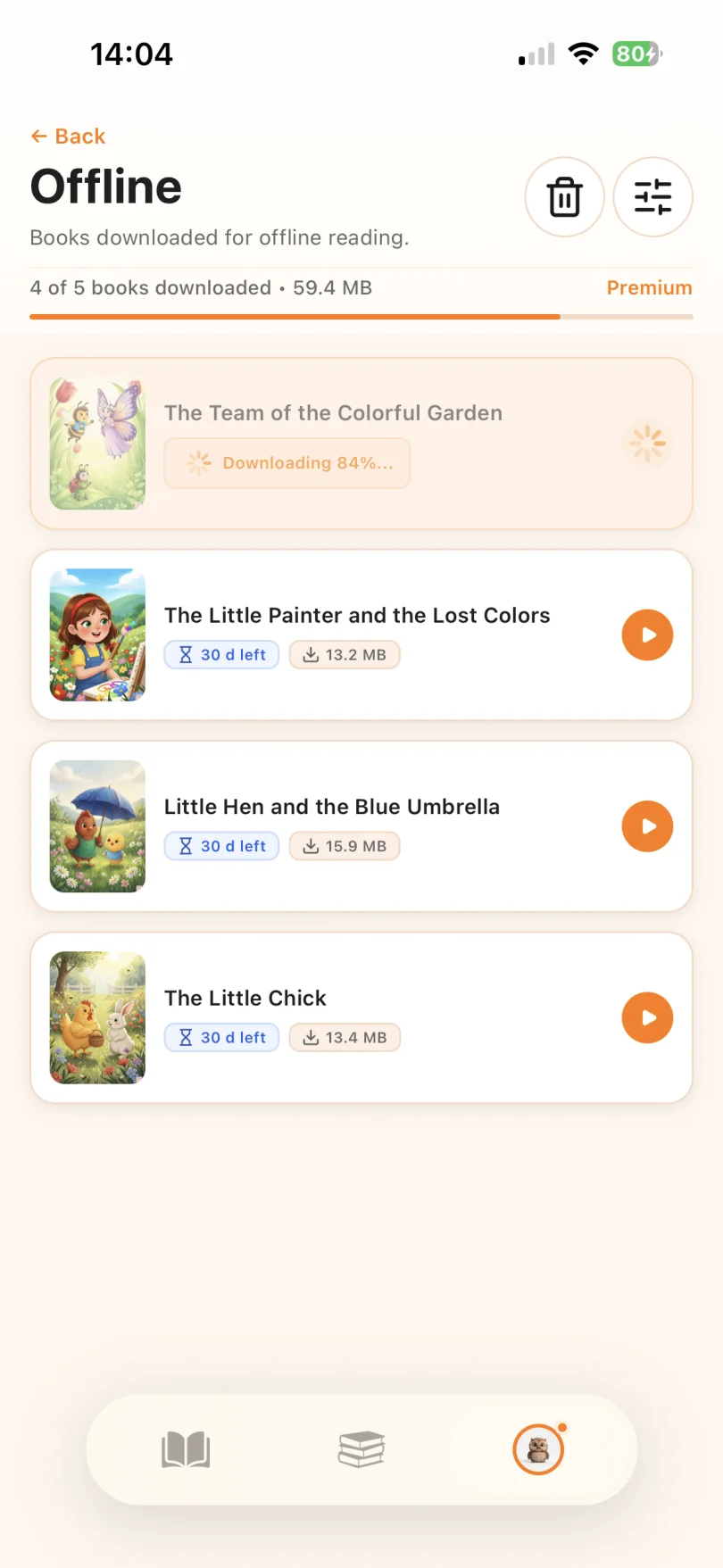
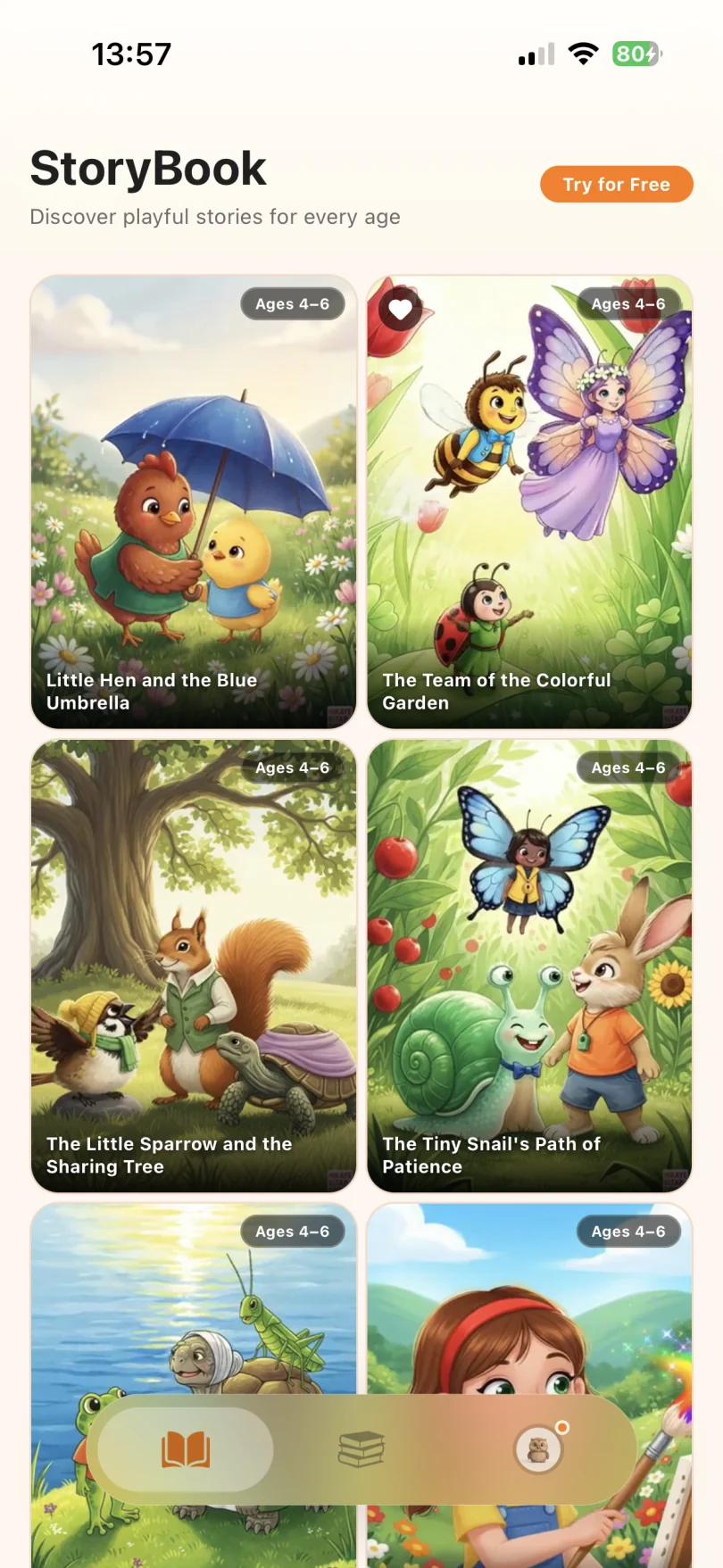
0-3 year old storybooks PDF options on StoryBook are short, bright picture books written for babies and toddlers: 7-15 pages, about 30 seconds to 2 minutes each, at the simplest A1.1 level. Every book can be read online, played with narration, or downloaded as a PDF to print and read together on paper.
What makes a “good” book changes fast between birth and age three. This guide focuses on what to consider at each stage, so you can judge any book, ours or a library’s, in a few seconds, followed by ten free examples and a 7-day starter routine.
10 Free Storybooks for Ages 0-3
| Book | Age | Level | Pages | Time |
|---|---|---|---|---|
| Where is the Colorful Fish? | 0-3 | A1.1 | 12 | 33 sec |
| What Do My Little Hands Do? | 0-3 | A1.1 | 12 | 43 sec |
| Goodnight, Sky | 0-3 | A1.1 | 12 | 51 sec |
| The Finger Play Book | 0-3 | A1.1 | 10 | 59 sec |
| The Dance of the Bubbles | 0-3 | A1.1 | 12 | 1 min 1 sec |
| I’m Tasting Fruits | 0-3 | A1.1 | 12 | 1 min 11 sec |
| My Bedtime Buddies | 0-3 | A1.1 | 12 | 1 min 15 sec |
| Big - Small | 0-3 | A1.1 | 10 | 1 min 27 sec |
| Cip is Looking for His Mommy | 0-3 | A1.1 | 12 | 1 min 33 sec |
| Let’s Find the Baby Animals | 0-3 | A1.1 | 15 | 1 min 57 sec |
What to Consider at Each Stage
Birth to 12 months: your voice and simple pictures
A young baby isn’t following a plot. They’re listening to the rhythm of your voice and looking at shapes and colors. What to look for:
- One clear picture per page with bold colors and plenty of contrast against the background.
- Very few words, ideally with rhythm or repetition, so the book is pleasant to read aloud many times.
- Calm endings for evening reading. Goodnight, Sky, where a child says goodnight to the sun, moon, and stars, takes under a minute and fits naturally into bedtime.
At this age, holding the book (or a printed page) close and pointing as you name things is the whole activity. It’s normal if your baby looks away after a page or two.
12 to 24 months: books that invite action
Toddlers want to join in. The best books for this stage give them something to do on every page:
- Pointing and finding: Where is the Colorful Fish? asks your child to spot fish in the sea.
- Body and movement: What Do My Little Hands Do? and The Finger Play Book invite clapping, wiggling, and copying.
- Familiar objects: books about bath time, food, or toys. The Dance of the Bubbles follows Can’s bubbly bath, and I’m Tasting Fruits follows Ali as he tries different fruits, so you can repeat the words at bath time or snack time.
Choose books where the words name what’s in the picture. “Ball,” “fish,” “clap” are the vocabulary your toddler is building right now.
24 to 36 months: tiny stories and big feelings
Two-year-olds start to follow a small story with a beginning, middle, and end, and they love predicting what comes next. Look for:
- A simple problem and a happy solution: in Cip is Looking for His Mommy, a tiny yellow chick searches for his mother and finds her at the end.
- Concepts: Big - Small compares objects by size, a useful early math idea.
- Routines: My Bedtime Buddies names pajamas, blankets, and other things that help with sleep, which can make the bedtime routine easier to talk about.
- Emotions: short moments of worry and relief, like in Cip’s search, help children start naming feelings.
Red Flags for This Age
- Busy pages where the main object is hard to find.
- Long sentences on each page; you’ll end up skipping text anyway.
- Scary or tense moments without a reassuring ending, especially for bedtime.
- Online sources with no age labels, auto-playing videos, or links that pull a child away from the book.
Using Narration, Screens, and PDFs With Little Ones
Pediatric guidance generally advises keeping screen time for babies and young toddlers very limited and always shared with an adult. With that in mind, a simple approach:
- Together on the screen: Sit with your child on your lap, play the narration, and point to each picture as it’s named. Pause and add your own words.
- On paper for bedtime: Print the PDF of a favorite book so evening reading happens without a bright screen.
- Little hands: Toddlers love turning pages themselves. A printed and stapled copy of a 10-12 page book gives them that, and a torn page is easy to reprint.
A 7-Day Starter Routine
Aim for 5 minutes once or twice a day. Repeat any book your child asks for; that’s a win, not a detour.
| Day | Book | Try this |
|---|---|---|
| Monday | Where is the Colorful Fish? | Point to each fish and count “one, two” together |
| Tuesday | What Do My Little Hands Do? | Do every action on the page: clap, wave, wiggle |
| Wednesday | The Dance of the Bubbles | Read it right before or after bath time |
| Thursday | I’m Tasting Fruits | Read at snack time and name the fruit you’re eating |
| Friday | Big - Small | Find one big and one small thing in the room |
| Saturday | Cip is Looking for His Mommy | Make a “peep peep” sound together as Cip searches |
| Sunday | Goodnight, Sky or My Bedtime Buddies | Print the PDF and read it in bed with the lights low |
For the next week, swap in The Finger Play Book and Let’s Find the Baby Animals. If you like tracking milestones, the printable reading log works for toddlers too; let them add a sticker for each book.
How to Download the PDF
- Click any title in the table to open the book page.
- Press “Download PDF”.
- Print on A4 or US Letter, “fit to page”. For extra durability, slip the pages into plastic sleeves.
Older siblings can color while you read; our coloring pages are free PDFs. Every printable title is collected in the free PDF children’s books library.
Questions and Prompts After Reading
At this age “questions” are mostly prompts to point, copy, or make a sound.
- Where is the Colorful Fish?: “Where’s the fish? Can you find another one?”
- Cip is Looking for His Mommy: “Where is Cip’s mommy? How does Cip feel when he finds her?”
- Big - Small: “Which one is big? Show me something small.”
- My Bedtime Buddies: “What helps you go to sleep? Where is your blanket?”
- Let’s Find the Baby Animals: “Who is the baby’s mommy? What sound does she make?”
Keep Exploring
All books for this age are on the ages 0-3 page, and when your child is ready for a little more story, the ages 4-6 shelf is the next step. For more on why early reading matters, see why read books to 0-3 year old babies, and for picks for a specific age, book recommendations for 2-year-olds.