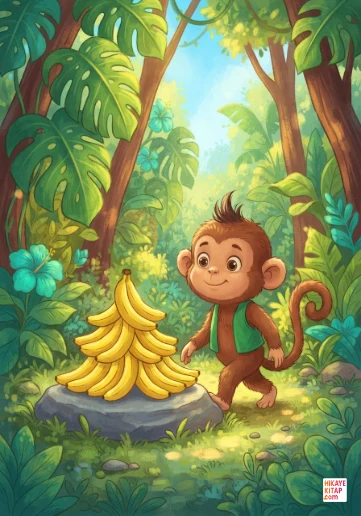
Good books for 4 year olds take two to three minutes to read, center on one small problem, and let the main character solve it themselves. At four, children are trying new things all day and often fail on the first attempt, so stories about building, waiting, sharing and trying again feel personal. These eight free picks can be read online, played with narration, or downloaded as a PDF.
What 4 year olds need from a story
Three year olds love repetition. Four year olds love repetition and a reason. They want to know why the tower fell, why the friend was sad, why the plan worked the second time. They also start to see themselves in characters: the monkey whose bananas keep tumbling is a lot like a child whose block tower just crashed.
The best stories for this age show a character who gets frustrated, stops, thinks and tries a different way, without an adult swooping in to fix everything.
8 free books for 4 year olds
| Book | Age | Level | Pages | Time | Why this one |
|---|---|---|---|---|---|
| Monty the Monkey and the Banana Tower | 4-6 | A2.1 | 12 | 2 min 55 sec | Tower falls until he builds a wider base |
| Pip the Little Elephant and the Sandcastle | 4-6 | A2.1 | 12 | 2 min 31 sec | Dry sand fails, wet sand works |
| HopHop the Sharing Rabbit | 4-6 | A2.1 | 10 | 1 min 54 sec | Thanks a helper with the bigger half |
| Fluffy the Little Bunny and the Carrot Clock | 4-6 | A2.1 | 12 | 3 min 7 sec | First look at clock hands |
| Whiskers and the Friend in the Mirror | 4-6 | A2.1 | 12 | 2 min 0 sec | Little experiments reveal his own reflection |
| Little Bear Barnaby and the Little Camp | 4-6 | A2.1 | 12 | 2 min 18 sec | Step-by-step camp, cozy in the dark |
| Daisy the Little Duck and the Rain Song | 4-6 | A2.1 | 12 | 2 min 1 sec | Rain sounds become a forest band |
| Phinney the Little Elephant and the Whisper Game | 4-6 | A2.1 | 12 | 2 min 43 sec | Learning when to whisper or shout |
Stories about trying again
Monty the Monkey and the Banana Tower
Monty wants a banana tower that reaches the sky. The first banana slides off the stone. He gets three to stand, but the fourth sends everything “thud, thud, thud” into the grass. He sits on the moss and asks, “Why does it keep falling?” Then he lays four bananas side by side as a base, adds three on top, and finishes a tower that does not wobble. Pause on the moss page and ask your child the same question before you turn it.
Pip the Little Elephant and the Sandcastle
Pip’s dry-sand tower cracks and slides. Instead of quitting, he sprays lake water from his trunk and finds that wet sand holds its shape. A turtle adds stone windows and a bird plants leafy flags. Try it yourself in a sandbox or a tub of sand: one tower dry, one damp.
Read these two back to back and ask, “What did Monty and Pip both do when things went wrong?” Four year olds are often surprised to spot the same pattern in two different stories.
Stories about friends and feelings
HopHop the Sharing Rabbit: HopHop’s carrot rolls under a thorny bush. Minnie the cat reaches through the thorns to get it, and HopHop snaps the carrot in two and hands her the big piece. It shows sharing as a way to say thank you.
Phinney and the Whisper Game: Phinney is so excited about a secret that he shouts it and nearly knocks Pip out of his tree. He feels shy when his friends giggle, keeps practicing until his voice is “soft as a cloud,” and the three friends pass whispered words to build a story. Practice the three voices together afterward: whisper, normal and outside voice.
Little Bear Barnaby and the Little Camp: Barnaby, Zippy and Ash choose a flat spot, tie the tent ropes, light lanterns and count stars. It is calming for children who feel uneasy about the dark.
Curious minds: clocks, mirrors and rain
Fluffy studies the kitchen clock while waiting for breakfast, finds the twelve at the top and learns from his mom that the long and short hands move “like a game of tag.” Whiskers tests the mirror cat by turning his head, jumping and lifting a paw until he realizes it is him. Daisy hears rain tapping on the roof and turns it into a song with a croaking frog and a squirrel clicking acorns. Each one ends with a small discovery your child can repeat at home.
Narration, PDFs and rereading
- Narration is great for a first listen. Your child hears sound words like “thud” and “tip-tap” with expression.
- Your reading the next day is where the learning happens: stop, ask, wait.
- The PDF download button on each book page lets you print a story. Four year olds enjoy retelling a printed book by turning the pages and “reading” the pictures to you. You can also find all printable titles on the free PDF children’s books page.
Signs a book is the right fit
A book is working when your child laughs at the right moments, asks “why?”, or wants it again tomorrow. It is too long if they keep asking “Is it done?” or start rolling around by page four. It is too easy if they recite it word for word and lose interest. Then ask a bigger question (“How else could Monty build his tower?”) or pick something from the ages 4-6 shelf with a few more pages.
A 7-day plan for 4 year olds
- Day 1: HopHop the Sharing Rabbit. Share a snack in two at lunch.
- Day 2: Monty and the Banana Tower. Build a block tower with a narrow base, then a wide one.
- Day 3: Pip and the Sandcastle. Compare dry and wet sand, or flour and damp flour.
- Day 4: Phinney and the Whisper Game. Play a whisper-telephone game at dinner.
- Day 5: Whiskers and the Friend in the Mirror. Make funny faces in a mirror together.
- Day 6: Daisy and the Rain Song. Tap a beat on pots and spoons.
- Day 7: Fluffy and the Carrot Clock or Barnaby’s camp. Build a blanket tent if you choose the camp.
Track the week on the free reading log.
Questions to talk about
- What did Monty change so his tower stopped falling?
- Why did HopHop give Minnie the bigger piece of carrot?
- What were the three voices Phinney learned to use?
- How did Whiskers figure out the cat in the mirror was him?
- What did Pip spray on the sand, and why did that help?
Keep going
For more on stories that teach kindness and sharing, read preschool values stories. For building a daily habit, see how to build a reading habit in children. Explore more in friendship stories and educational stories.








