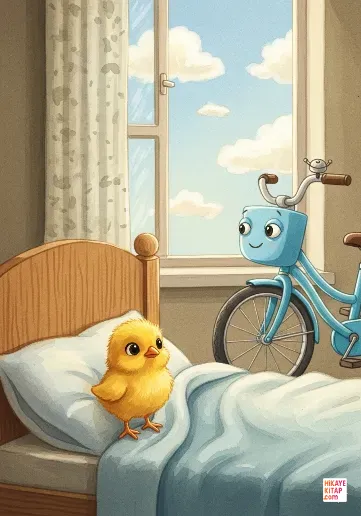
The best books for 3 year olds are short (one to three minutes), built on a line that repeats, and full of things a preschooler already knows: animals, vehicles, fruit, bath time. At three, children start to follow a tiny plot and guess what happens next. All eight picks below are free to read online, can be played with narration, and download as a PDF.
What changes at age three
Toddlers enjoy naming things on a page. Three year olds start caring about why: why the chick is looking for his mommy, why the frog needs his leaf. A good book at this age has a small want, a few tries and a happy ending. Repetition is what makes it work. Once your child catches a pattern, they start saying it with you, and that is when new vocabulary sticks.
Three year olds also love being asked for help. “Where should Pip look next?” turns listening into playing.
8 free read-aloud books for 3 year olds
| Book | Age | Level | Pages | Time | Why this one |
|---|---|---|---|---|---|
| Pip Looks for His Mommy | 0-3 | A1.1 | 10 | 1 min 12 sec | Vehicle sounds on every search stop |
| Little Frog and the Green Leaf | 0-3 | A1.1 | 12 | 2 min 10 sec | One leaf becomes six different things |
| Little Rabbit and the Bluebell | 0-3 | A1.1 | 12 | 2 min 49 sec | Small helpful jobs with each friend |
| Little Pelican and the Pink Seashell | 0-3 | A1.1 | 12 | 2 min 22 sec | Explores a shell, then returns it |
| Little Raki and His Tiny Boat | 0-3 | A1.1 | 12 | 2 min 47 sec | Slow, patient boat ride with counting |
| I’m Tasting Fruits | 0-3 | A1.1 | 12 | 1 min 11 sec | Five fruits, five colors, five tastes |
| What Am I Wearing Today? | 0-3 | A1.1 | 12 | 1 min 4 sec | Dressing for sun, rain and snow |
| The Dance of the Bubbles | 0-3 | A1.1 | 12 | 1 min 1 sec | Bath-time bubbles big, tiny and long |
If your child is new to sitting through a story, start with the one-minute books (bubbles, clothes, fruit) and save Little Rabbit and Little Raki, both close to three minutes, for later in the week.
Why these books work at three
A big feeling, safely solved: Pip Looks for His Mommy
Pip the chick wakes up alone and goes looking. He meets a car going “vroom vroom,” a bus, a train, a boat, a plane, a fire truck, an ambulance, a tractor and a motorcycle before he finds Mommy beside a ringing bicycle. Make each sound yourself the first time; on the second read, pause and let your child make it.
Pretend play on paper: Little Frog and the Green Leaf
Pipi’s big leaf turns into a hat, an umbrella for Mimi the mouse, a bed, a boat, a slide and finally a tent. Before you read what it becomes, cover the text and ask your child to guess from the picture. Afterward, hand them a dish towel and see what it can become.
Looking without keeping: Little Pelican and the Pink Seashell
Pelin’s friends each explore the shell a different way: one feels how smooth it is, one traces its lines, one hears the ocean inside. Then Neşe the dolphin says the shell belongs to the beach, and Pelin puts it back. It is a gentle script for the next time your child wants to pocket every pinecone at the park.
Everyday routines: fruit, clothes and bath
I’m Tasting Fruits, What Am I Wearing Today? and The Dance of the Bubbles are built around things your child does every day. They make good “before” books: read the clothes book while picking an outfit, or the bubble book right before bath.
How to use narration and the PDF button
Every book page has a play button for narration and a PDF download button.
- Narration first, then you. Play the story once so your child hears the rhythm and the sound words. Then read it yourself the next day, stopping to point and ask.
- PDF for offline and coloring. Save a few books before a road trip or a waiting room visit. Print a page from Little Frog and let your child color the leaf, or browse the free coloring books.
For every printable title in one place, see free PDF children’s books.
Too hard or too easy?
Too hard: your child wanders off by page two, ignores the pictures, or never answers questions. Switch to a shorter book or just talk about the pictures without reading the words.
Too easy: they recite the story before you get there and flip pages fast. Keep the book but ask harder questions: “What would Pip do if he couldn’t find Mommy?” When they are ready for longer stories, the ages 4-6 shelf is the next step.
A 7-day read-aloud plan
- Monday: What Am I Wearing Today? Read it while getting dressed.
- Tuesday: Pip Looks for His Mommy. Do every vehicle sound together.
- Wednesday: I’m Tasting Fruits, then taste one real fruit from the book.
- Thursday: Little Frog and the Green Leaf. Guess each new use before reading it.
- Friday: The Dance of the Bubbles at bath time.
- Saturday: Little Pelican and the Pink Seashell, then a short nature walk.
- Sunday: Your child picks: Little Rabbit, Little Raki, or the week’s favorite again.
Mark each finished book on the free reading log. Three year olds love adding a sticker.
Questions to ask after reading
- Which vehicle did Pip meet just before he found Mommy? What sound did it make?
- What did Pipi’s leaf turn into when it rained? What was it at bedtime?
- Why did Pelin put the pink seashell back on the sand?
- In I’m Tasting Fruits, which fruit was fuzzy and brown on the outside?
- What did Can’s long bubble look like?
Where to go next
For the bigger picture on reading with little ones, see why read to 0-3 year olds and bedtime stories for a calming routine. Browse more on the ages 0-3 page, in animal stories and daily life, or read on your phone with the app.








