Stories that teach sharing show a character who first wants to keep something and then discovers what happens when they share it. The eight free books below run from toddler board-book style to ages 12, and they cover very different kinds of sharing: food, turns, a glowing stone, a cave of treasure, even the credit for a win.
To reinforce the topic with more stories, see our audio stories about values.
Why sharing is hard
To a young child, a toy can feel like part of themselves, so “share” can sound like “lose.” That’s why the most effective way to teach sharing is usually showing what comes after, not ordering it. Stories do this beautifully: Pip shares his berry and gains a friend; Bibi lends her glowing stone and the light doesn’t shrink at all.
Unlike our preschool values stories roundup, this list stretches into elementary school, so older siblings can find something at their level too.
8 stories about sharing
| Book | Age | Level | Pages | Time | Why this one |
|---|---|---|---|---|---|
| The Journey of Sepi the Little Hazelnut Basket | 0-3 | A1.1 | 10 | 1 min 54 sec | A basket shares a hazelnut with each friend |
| HopHop the Sharing Rabbit | 4-6 | A2.1 | 10 | 1 min 54 sec | Thanking a helper by sharing a carrot |
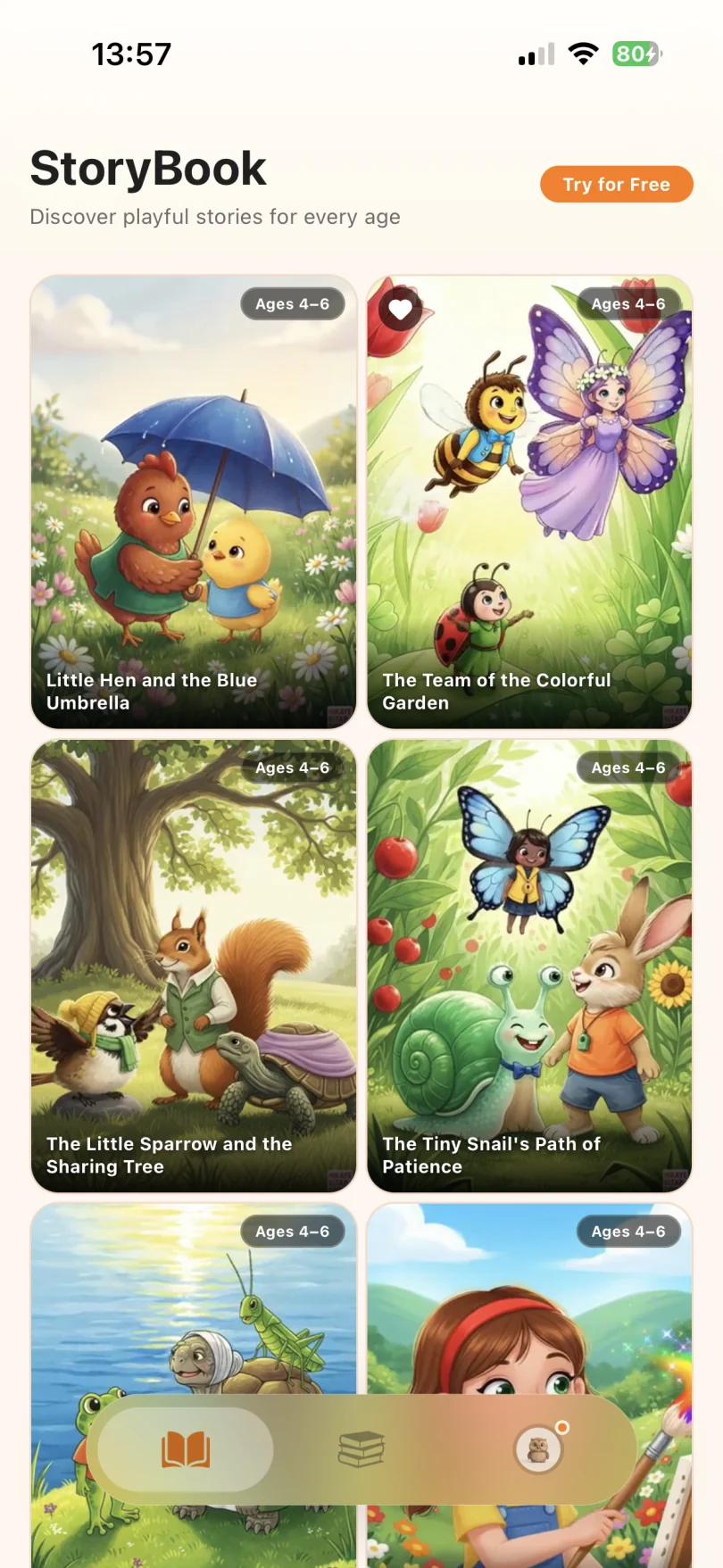
| The Little Sparrow and the Sharing Tree | 4-6 | A2.1 | 12 | 2 min 54 sec | A sparrow learns friends beat food |
| The Mystery of the Glowing Stone | 4-6 | A2.1 | 12 | 3 min 5 sec | Taking turns with a glowing stone |
| The Little Chick | 4-6 | A2.1 | 12 | 1 min 56 sec | A strawberry for a hungry rabbit |
| Hasan and the Shared Treasure | 7-9 | A2.2 | 15 | 3 min 53 sec | A woodcutter shares cave treasure |
| Eren and the Bright Lamp | 7-9 | A2.2 | 14 | 2 min 55 sec | An Aladdin-style lamp used only for good |
| The Curious Squirrel and the Lost Acorn | 10-12 | B1 | 12 | 2 min 45 sec | Sharing the win with the team |
For more, browse emotions and values and friendship stories.
Five kinds of sharing
Sharing isn’t one behavior. Reading these stories through five lenses shows kids that sharing means more than “giving stuff away.”
1. Sharing food. In The Journey of Sepi the Little Hazelnut Basket, a basket full of hazelnuts shares one with each friend he meets, and at sunset everyone gathers at the stone cottage. Its repetition makes it ideal for ages 0-3. In The Little Chick, the chick gives a hungry rabbit named Cotton a strawberry and hands Hazel the squirrel an acorn.
2. Giving back to a helper. In HopHop the Sharing Rabbit, HopHop’s carrot rolls under a thorny bush and a kind friend, Minnie, helps get it out. HopHop says thank you and shares the carrot. It’s a gentle way to link gratitude and generosity.
3. Taking turns. In The Mystery of the Glowing Stone, Bibi the fish discovers a glowing stone in a dark hollow. Instead of hiding it, she plays with Seli and Oktu and they take turns sharing the light. It’s the most concrete way to explain turns for something that can’t be split.
4. Opening a treasure to everyone. Hasan and the Shared Treasure echoes Ali Baba: a kind woodcutter discovers a cave full of gold, fills only a small pouch, and shares it with his village. In Eren and the Bright Lamp, an Aladdin-style tale, Eren chooses to use a magic lamp only for good. Both suit ages 7-9.
5. Sharing success. In The Curious Squirrel and the Lost Acorn, Cici finds her prized acorn with her friends’ help, then brings out three plump hazelnuts for them, noting that success is sweeter when shared. It’s great for asking older kids, “Who deserves credit when a team wins?”
At the center sits The Little Sparrow and the Sharing Tree. Pip tucks his golden seed away to keep it for himself, but after a squirrel named Brio gives him a gift, Pip offers half of his juicy berry, and learns that food is good but friends are even better.
Encouraging sharing without forcing it
Stories are a starting point. A few everyday strategies help too:
- Use a turn timer. When siblings want the same toy, say “Let’s take turns like Bibi and her friends” and set a short timer.
- Allow a few special things. Every child can have one or two items they don’t have to share. Putting them away before playdates heads off conflict.
- Name the feeling. “You don’t want to give up your carrot because you love it” shows your child they’ve been understood.
- Notice spontaneous sharing. When it happens on its own, respond with a short, specific “That was just like Pip!”
Sharing between siblings
Most sharing battles happen at home between siblings. Constantly telling the older child “You’re bigger, give it to her” can turn sharing into a punishment. Small, fair rules work better: whoever had it first gets the first turn, swap when the timer ends, and keep separate bins for shared toys and personal ones. Stories give siblings a common language, too. When a fight starts, “What did Bibi and Seli do?” points to a solution without blaming anyone. Asking the older child to read Sepi’s journey to the younger one gives them responsibility and a shared moment.
A classroom idea
After listening to the sparrow story, set up a “sharing corner” where students bring one book, game or fact card from home and use each other’s items for a week. At the end, each child tells how someone else used what they brought. It shows, concretely, that sharing multiplies rather than subtracts.
A 7-day sharing plan
- Day 1: The Journey of Sepi the Little Hazelnut Basket (great with siblings)
- Day 2: HopHop the Sharing Rabbit
- Day 3: The Little Chick
- Day 4: The Little Sparrow and the Sharing Tree. Split a piece of fruit at dinner.
- Day 5: The Mystery of the Glowing Stone. Play a turn-taking game with one toy.
- Day 6: Hasan and the Shared Treasure or Eren and the Bright Lamp
- Day 7: For an older child, The Curious Squirrel and the Lost Acorn
Questions to talk about
- Sepi’s basket got emptier as he shared. What grew instead?
- Why did HopHop share his carrot with Minnie?
- Why did Pip hide his seed at first? What changed his mind?
- How would Bibi’s story have ended if she had kept the stone to herself?
- Why did Hasan take only a small pouch and share it with the villagers? What would you have done?
After a sharing activity, siblings can color together with the free coloring books.