The best books for 6 year olds have a real story and a small challenge built in: something to count, compare, sort or remember. At six, many children are in kindergarten or first grade, and they enjoy using new school skills inside a story. These eight free books can be read online, played with narration, or downloaded as a PDF.
What six year olds get out of a picture book
Six year olds are figuring out how the world is measured and organized. They want to know which is longer, how many are left and how long a minute really lasts. They also like being “the one who knows.” A story where a character works something out gives your child a model and then a chance to try the same thing at the kitchen table.
These books are not workbooks. Each one is a short story first, with the math or word idea arising naturally from the plot.
8 free books for 6 year olds
| Book | Age | Level | Pages | Time | Why this one |
|---|---|---|---|---|---|
| Merve’s School Bag Countdown | 7-9 | A2.2 | 12 | 3 min 34 sec | Counting supplies on the first school morning |
| First Numbers for Little Hands | 4-6 | A2.1 | 10 | 1 min 42 sec | One sun to ten fingers |
| Little Seal Bubbles and the Hourglasses | 4-6 | A2.1 | 10 | 2 min 19 sec | Racing to collect shells before sand runs out |
| Toby the Little Turtle and the Long Leaf | 4-6 | A2.1 | 12 | 3 min 7 sec | Ordering leaves by length, then width |
| Little Gigi the Giraffe and the Colorful Ribbons | 4-6 | A2.1 | 10 | 2 min 55 sec | Two right ways to sort ribbons |
| Mittens and the Missing Ribbon | 4-6 | A2.1 | 12 | 3 min 8 sec | Stop, think and retrace yesterday |
| Pip and the Colorful Words | 4-6 | A2.1 | 12 | 3 min 45 sec | Mistakes as the fun part of learning |
| Little Kevin and the Sleeping Bird | 4-6 | A2.1 | 12 | 2 min 16 sec | A quiet game so a friend can sleep |
Merve’s School Bag Countdown is listed in the 7-9 range and has longer text than the rest, so read it aloud rather than expecting your child to read it alone.
Counting and time
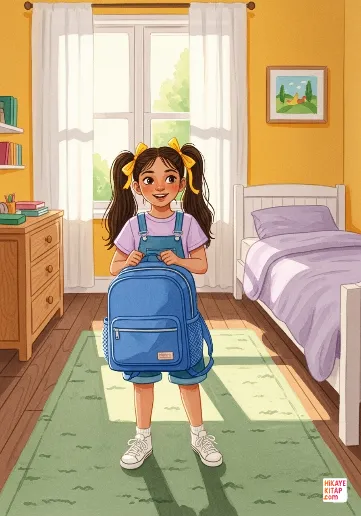
Merve’s School Bag Countdown
On her first school morning, Merve and her mom, Ayla, pack her blue backpack as a counting game: five notebooks, eight erasers, sixteen pencils, three sharpeners, twelve markers and twenty gold stickers. When Pamuk the cat bats the ruler, Merve counts “one ruler.” The night before school starts, pack your child’s bag the same way and count each item aloud.
First Numbers for Little Hands
This one is shorter and simpler: one sun, two clouds, three flowers, four bees, all the way to nine stars. Number ten is not in a picture; it is on your child’s own hands. Use it as a quick warm-up, or with a younger sibling.
Little Seal Bubbles and the Hourglasses
Bubbles finds a glass full of golden sand, flips it and watches the sand flow. She and Barnaby race to collect seashells before it runs out. Grab a kitchen timer and try the same race with socks to pair or toys to put away. It turns “one minute” into something a six year old can feel.
Comparing and sorting
Toby the Little Turtle and the Long Leaf compares one long leaf with a short heart-shaped leaf and a huge round lotus leaf, then lines everything up from shortest to longest like a staircase. When Vivie arrives, they sort the same leaves by width. Collect five leaves on a walk and do both.
Little Gigi the Giraffe and the Colorful Ribbons makes a great follow-up. Gigi lines up three ribbons by length; Ellie wants to group them by color. After moving them back and forth, they agree both ways are right. Ask your child for a third way to sort the same objects.
Mittens and the Missing Ribbon is about memory and calm. Mittens tears through her toy box and crawls under the bed, but what works is sitting on her stool, remembering that she danced by the hallway mirror the day before, and finding the ribbon caught on a chair leg there.
Words, mistakes and kindness
In Pip and the Colorful Words, a parrot teaches his friends “hello,” “flower” and “butterfly.” When Max says “Butter-fly-fly” and feels shy, Pip tells him mistakes are the most fun part of learning. That line is worth repeating to a six year old who has just started reading and gets frustrated with tricky words.
Little Kevin and the Sleeping Bird shows a classroom-ready skill: noticing others. Kevin sees Chirpy asleep on a low branch and invents a quiet game, making shapes from fallen leaves, so his friends can play without waking her.
Narration and the PDF download
- Narration first gives your child the rhythm of the longer books and frees you to point at the pictures.
- Your read is where you pause: “How many pencils so far?” “Which leaf is wider?”
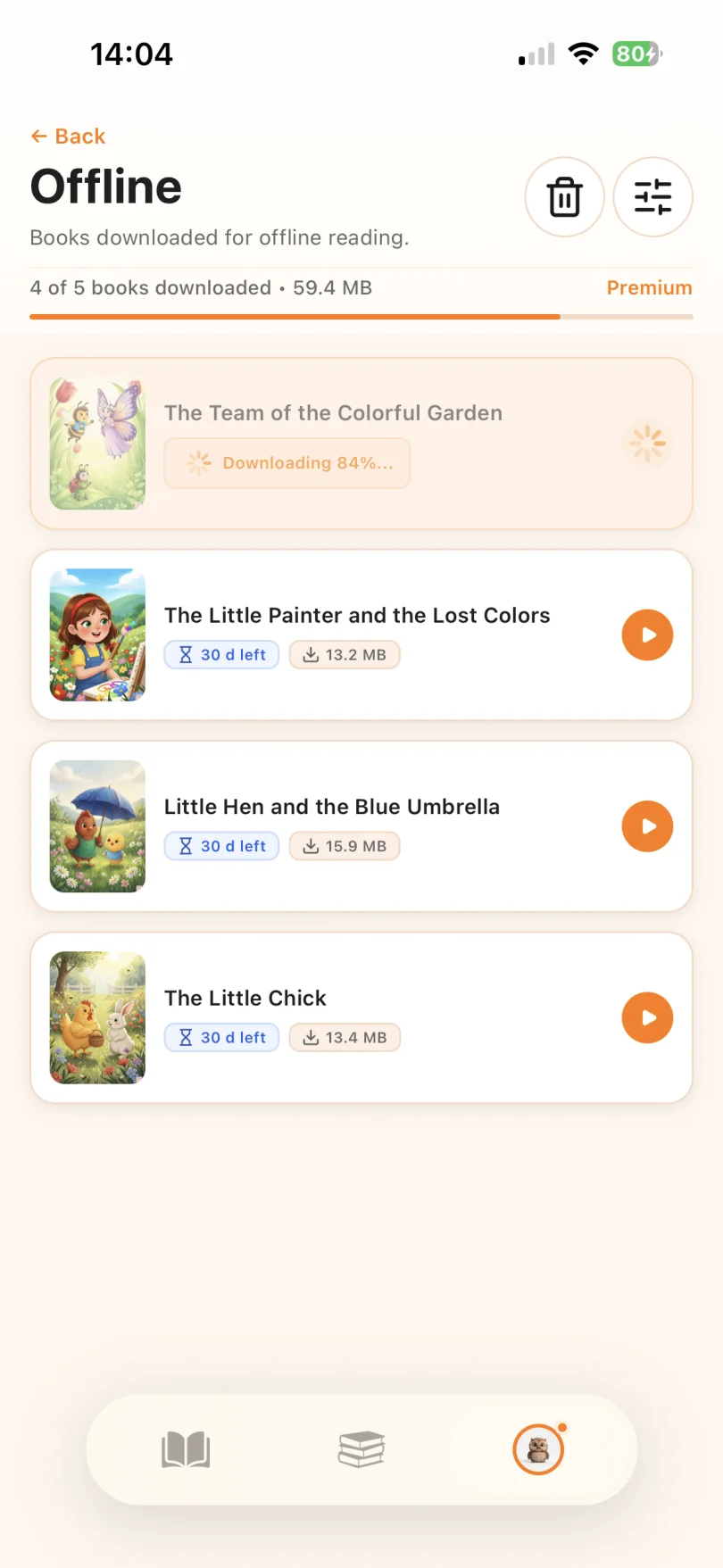
- The PDF download on each book page lets you print a story. Print Toby’s leaf pages and have your child cut out and order the leaves, or print Merve’s book and tick off each school item as you pack. You’ll find every printable title on the free PDF children’s books page.
Too easy, too hard?
If your child answers every question instantly, raise the bar: “If Merve gave away two of her eight erasers, how many would she have?” If they lose interest, choose the shorter books (First Numbers, Kevin, Bubbles) and shorten the activity. The ages 4-6 shelf has plenty more short stories, and the ages 7-9 shelf has longer read-alouds for when they want more.
A 4-week plan at home
- Week 1, counting: First Numbers for Little Hands and Merve’s School Bag Countdown. Count things during everyday jobs.
- Week 2, time: Little Seal Bubbles and the Hourglasses. Do two “beat the timer” races.
- Week 3, comparing and sorting: Toby and the Long Leaf, then Gigi and the Colorful Ribbons. Sort laundry, leaves or blocks in two different ways.
- Week 4, learning habits: Pip and the Colorful Words, Mittens and the Missing Ribbon, Kevin and the Sleeping Bird. Talk about what to do when something is hard, lost, or when someone needs quiet.
Log each story on the free reading log.
Discussion questions
- How many pencils did Merve pack? Which item had the biggest number?
- What did Toby compare his long leaf to first?
- Gigi and Ellie sorted ribbons two ways. What were they?
- Where did Mittens finally find her ribbon, and what helped her remember?
- What did Pip tell Max after he mixed up his words?
Keep reading
When your child starts first grade, see free story books for 1st graders. For a younger child, free kindergarten story books has more ideas. Browse educational stories and school life for more.