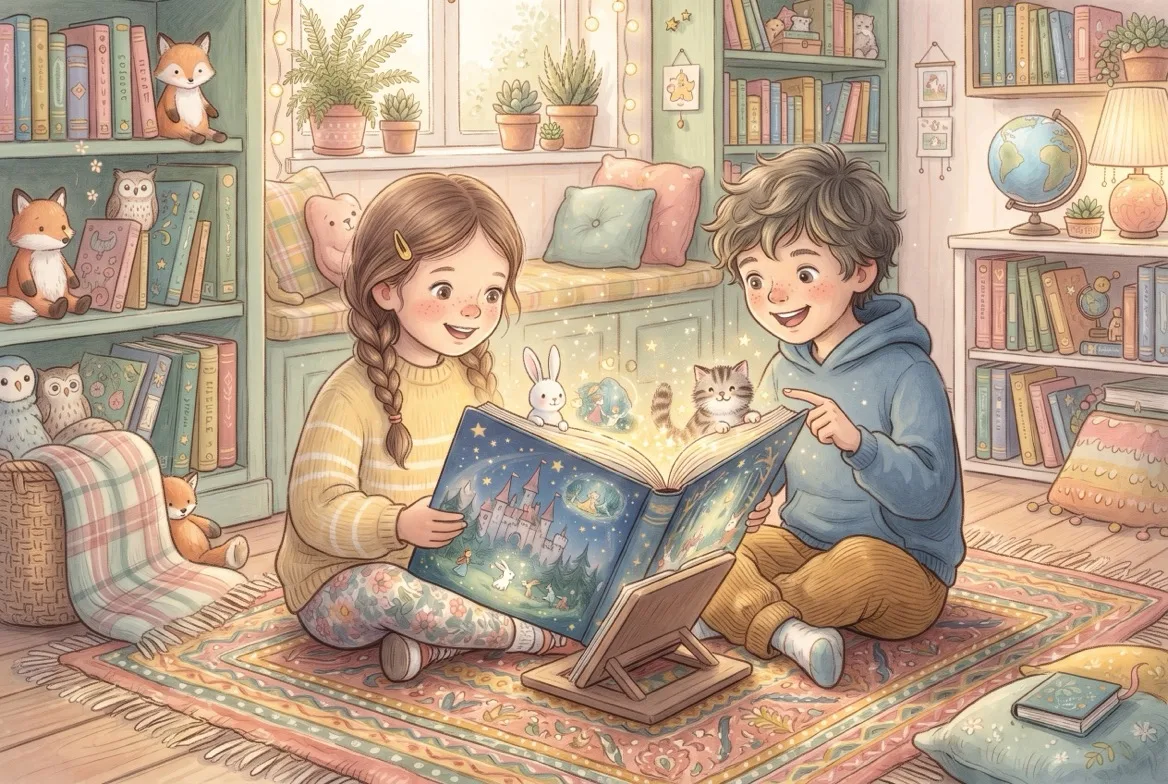
Short answer: Our free story books for 1st and 2nd graders (roughly ages 6-8) are short illustrated stories at levels A2.1-A2.2, 10-15 pages long and about two to four minutes each with narration. Every book is free to read online, listen to with audio, or download as a printable PDF.
This guide is about the in-between: the summer from 1st to 2nd grade, and homes where one child is in 1st grade and a sibling is in 2nd. If you only need a single-grade list, our guides to story books for 1st graders and story books for 2nd graders are a better fit.
What Changes Between 1st and 2nd Grade
In 1st grade, children connect letters to sounds, blend them into words, and read short sentences. In 2nd grade, the expectation shifts toward reading smoothly and retelling a story in their own words. The summer in between is when many parents notice the “summer slide”: in September, a child who was reading happily in June suddenly sounds out every word again.
The simplest fix is daily contact with text your child can read without struggling. During this stretch, rereading an easy book builds more fluency than wrestling with a hard one.
Paired Book List for Two Levels
The books below are chosen in pairs on the same theme. The younger child (or the one just finishing 1st grade) reads the A2.1 book, the older child reads the A2.2 book, and then they compare the two stories.
| Book | Age | Level | Pages | Time |
|---|---|---|---|---|
| Ada’s Number Adventure | 4-6 | A2.1 | 12 | 2 min 33 sec |
| Merve’s School Bag Countdown | 7-9 | A2.2 | 12 | 3 min 34 sec |
| The Rabbit and the Tortoise | 4-6 | A2.1 | 12 | 2 min 0 sec |
| The Little Tortoise’s Big Dream | 7-9 | A2.2 | 15 | 3 min 48 sec |
| Pip and the Lake of Courage | 4-6 | A2.1 | 12 | 2 min 38 sec |
| The Dragon and the Brave Boy | 7-9 | A2.2 | 10 | 2 min 33 sec |
| The Wise Crow and the Cunning Fox | 4-6 | A2.1 | 12 | 2 min 17 sec |
| The Secret of the Lighthouse | 7-9 | A2.2 | 10 | 2 min 42 sec |
| Barnaby the Little Bear and the Forest’s Tiny Postman | 4-6 | A2.1 | 12 | 3 min 8 sec |
| Elara and the Little Bird | 7-9 | A2.1 | 10 | 1 min 34 sec |
The pairs: counting (Ada and Merve), patience (the two tortoise stories), courage (Pip and the dragon), clever thinking and mystery (the crow and the lighthouse), and friendship and responsibility (Barnaby and Elara).
Is the Level Right? The Five-Finger Rule
Open the book to any page. As your child reads, raise one finger for each word they can’t read or don’t know:
- 0-1 fingers: Easy. Perfect for fluency and confidence; reread these often over the summer.
- 2-4 fingers: Just right. Your child works a little but doesn’t lose the meaning.
- 5 or more: Too hard for now. Listen to it with narration first and try again in a few weeks.
Most children finishing 1st grade land at 0-2 fingers on the A2.1 books. Don’t rush to A2.2. By the third read of the same book, speed and expression usually improve noticeably, and that progress is what carries into 2nd grade.
Reading with Siblings: Four Setups That Work
When two children in different grades share a reading time, the goal is teamwork, not a race. A few setups families find useful:
- Sentence by sentence: The older child reads one sentence, the younger reads the next. If the younger one gets stuck, the older one may give a hint, but not the word itself.
- Teacher for a day: The 2nd grader reads an easier A2.1 book aloud to the 1st grader. The older child practices expression; the younger one hears a model reader who isn’t a grown-up.
- One theme, two books: Pick a pair from the table. Each child reads their own book, then you ask a comparison question like “Which tortoise was more patient?”
- Listen, read, retell: Both listen to the narration together, each reads one page aloud, and the younger child retells the story using the pictures.
Avoid comparing the two children’s speed. Comparing the younger child with their own reading from last week is far more motivating.
Using Narration and the PDF Together
You don’t have to choose between screen and paper; they do different jobs:
- Narration on screen: For meeting a story for the first time, hearing natural expression, and learning how new words sound.
- The printed PDF: For reading in the child’s own voice, following the line with a finger. Lightly circling tricky words in pencil gives you tomorrow’s practice list.
This “listen first, then read” order suits brand-new readers well. If you’d like to track speed, the reading speed test once a month is plenty; just don’t turn the number into pressure.
A 4-Week Plan for Summer or the Start of 2nd Grade
Ten to twenty minutes a day is enough. Weekends can be free-choice days.
| Week | Younger child / end of 1st grade | Older child / 2nd grade | Shared activity |
|---|---|---|---|
| 1 | Ada’s Number Adventure (listen, then read) | Merve’s School Bag Countdown | A counting hunt around the house, 1 to 10 |
| 2 | The Rabbit and the Tortoise | The Little Tortoise’s Big Dream | Compare the two tortoises |
| 3 | Pip and the Lake of Courage | The Dragon and the Brave Boy | Draw “a time I was brave” |
| 4 | Barnaby the Little Bear and the Forest’s Tiny Postman | The Secret of the Lighthouse | Write each other a short letter |
Read each week’s book at least three times: day one listening, day two reading together, day three reading alone. Log finished books on the printable reading log; printing the certificate at the end of the month is a concrete reward for both siblings. With a free account, reading history and badges are saved automatically.
How to Download the PDF
- Click a title in the table to open the book page.
- Press the Download PDF button.
- Print on A4 or letter paper. Printing two copies lets each sibling mark up their own pages.
For a quiet break after reading, each book page also lets you download its illustrations as coloring pages, and more are in the coloring books section. All printable titles are collected in the free PDF children’s books library.
Questions to Ask After Reading
- The Rabbit and the Tortoise / The Little Tortoise’s Big Dream: Both tortoises are slow but determined. Who helped Toby on his climb to the highest peak? Did the tortoise in the race need any help?
- Pip and the Lake of Courage: Pip beats a big fear with tiny brave steps. What was Pip’s first small step? Who would you want next to you when you feel scared?
- The Dragon and the Brave Boy: Why was everyone afraid of Emerald the dragon? What did Arda notice that the others missed?
- The Secret of the Lighthouse: What clues did the three friends follow to solve the mystery of the old key?
- Barnaby the Little Bear: Barnaby crosses a wooden bridge to deliver a lost invitation to Lily the rabbit. What makes someone a reliable postman?
Next Steps
Find every younger title on the ages 4-6 page and longer A2.2 stories on the ages 7-9 page. Families who read at bedtime on a phone can use the same library in our iOS and Android app.








