The best books for newborns are not really books at all at first: they are your voice, your face, and a few bold shapes held close. Newborns tend to see strong black-and-white contrast more easily than soft colors, and over the next few months they start tracking bright pictures and responding to simple sounds. This guide covers what to do in each stage and which very short free books fit once your baby is ready for color.
An honest note before we start
Every book on HikayeKitap is illustrated in full color. We do not have black-and-white newborn books, so for the first weeks we suggest a homemade alternative below. Around the time your baby starts noticing color, the shortest books on the site become a good fit.
What a newborn gets from “reading”
A newborn won’t follow a plot. What they take in is rhythm, tone and closeness: the rise and fall of your voice, the way your face changes, the warmth of being held. When your baby makes a small sound and you answer, you are having one of their first conversations.
A few practical tips:
- Hold it close. Keep a card or page roughly 8 to 12 inches (20 to 30 cm) from your baby’s face.
- Keep it short. One to three minutes is enough.
- Pick a calm, alert moment. After a feed and a diaper change, before your baby gets sleepy, often works well.
Weeks 1-8: DIY high-contrast cards
Grab some thick white card and a black marker. Draw one bold shape per card: a big circle, a zigzag, a checkerboard, stripes, and a simple face with two dots and a smile. Hold a card in your baby’s view and slowly move it side to side while you narrate: “Here’s a big circle. Round and round.”
Those short lines are your first read-aloud. Later you’ll carry the same rhythm into real books.
Months 3-6: first color books
As babies grow, they start telling colors apart, reaching for things and copying sounds. That is a good time to try the books below. Each one is very short, and several finish in under a minute.
| Book | Age | Level | Pages | Time | Why this one |
|---|---|---|---|---|---|
| The Little Lantern’s Coastal Garden | 0-3 | A1.1 | 10 | 36 sec | Two short lines of “good morning” per page |
| Let’s Open the Toy Box | 0-3 | A1.1 | 12 | 47 sec | Sound clues before each toy appears |
| The Little Train Cars | 0-3 | A1.1 | 12 | 54 sec | “Choo choo” and one more car each page |
| The Morning Scent in the Little Chestnut House | 0-3 | A1.1 | 10 | 54 sec | Waking, opening a window, picking berries |
| Cotton Cloud’s Little Journey | 0-3 | A1.1 | 10 | 57 sec | Rhyming hellos from a floating cloud |
| The Finger Play Book | 0-3 | A1.1 | 10 | 59 sec | Clap, wave, hug: one move per page |
| Little Kitten Cotton’s Garden | 0-3 | A1.1 | 12 | 1 min 8 sec | Red ball, yellow flower, blue butterfly |
| Good Night, My Animal Friends | 0-3 | A1.1 | 12 | 1 min 11 sec | Slow good-nights for a bedtime routine |
How to read them with a baby
The Little Lantern’s Coastal Garden has just two short lines per page. The lantern says good morning to a snail, a seagull, blue flowers, green leaves, the sea and the breeze. Say each “good morning” slowly and point to the picture.
The Finger Play Book is made for moving. Peep the chick asks you to clap, touch your nose, wave, hug yourself, wiggle fingers and stomp feet. With a young baby, do the moves gently with their hands and feet while they lie on their back.
Let’s Open the Toy Box uses a sound before each toy: tap tap, then a teddy bear; vroom vroom, then a car. Make the sound, pause, then show the page.
The Little Train Cars adds one car per page, from one red car to ten colorful ones. At this age, counting isn’t the point. The steady “choo choo” rhythm is.
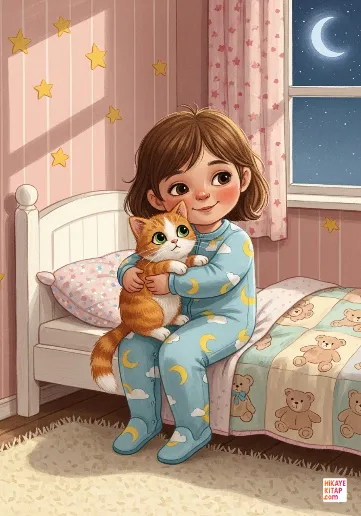
Good Night, My Animal Friends fits a bedtime routine. Elif says good night to a purring kitty, a yawning dog, lambs snuggled by their mothers and an owl calling “hoo hoo.” Lower your voice a little more on each page. Reading the same book every night helps your baby learn that sleep is coming.
Narration and PDFs at this age
Your live voice is the best audio there is. If you want to use the narration on a book page, play it once for yourself to hear the pacing, then read it to your baby in your own voice. Rather than holding a screen in front of your baby, use the PDF download button to save the book and print a few pages on heavy paper. Prop them up during tummy time or tuck one beside the changing table. All printable titles are on the free PDF children’s books page.
Reading your baby’s cues
Signs of interest: eyes on the page, turning toward your voice, kicking or waving, little coos. Signs of “that’s enough”: turning away, fussing, arching, yawning. There is no need to finish a book. One page your baby enjoys is a success.
A month-by-month starter plan
- Month 1: High-contrast cards once or twice a day, one sentence per card.
- Month 2: Add a nursery rhyme or the same short text every day, read in your lap.
- Month 3: Try The Little Lantern’s Coastal Garden and Let’s Open the Toy Box.
- Month 4: Add The Finger Play Book and do the moves with your baby’s hands.
- Month 5: Little Kitten Cotton’s Garden and The Little Train Cars for colors and sound words.
- Month 6: Choose one bedtime book, like Good Night, My Animal Friends or Cotton Cloud’s Little Journey, and read it every night.
Things to say while you read
Questions at this age are for rhythm. You answer them yourself:
- “What came out of the box? A teddy bear! Soft, brown teddy.”
- “Good morning, little snail! Can you say good morning?”
- “How many train cars? One red car. Choo choo!”
- “Good night, little kitty. Good night, sleepy dog. Good night, you.”
What comes next
As your baby grows, browse the ages 0-3 page for slightly longer stories. For the bigger picture on early reading, see why read books to 0-3 year old babies and benefits of audio children’s books. The bedtime stories page has more wind-down picks.