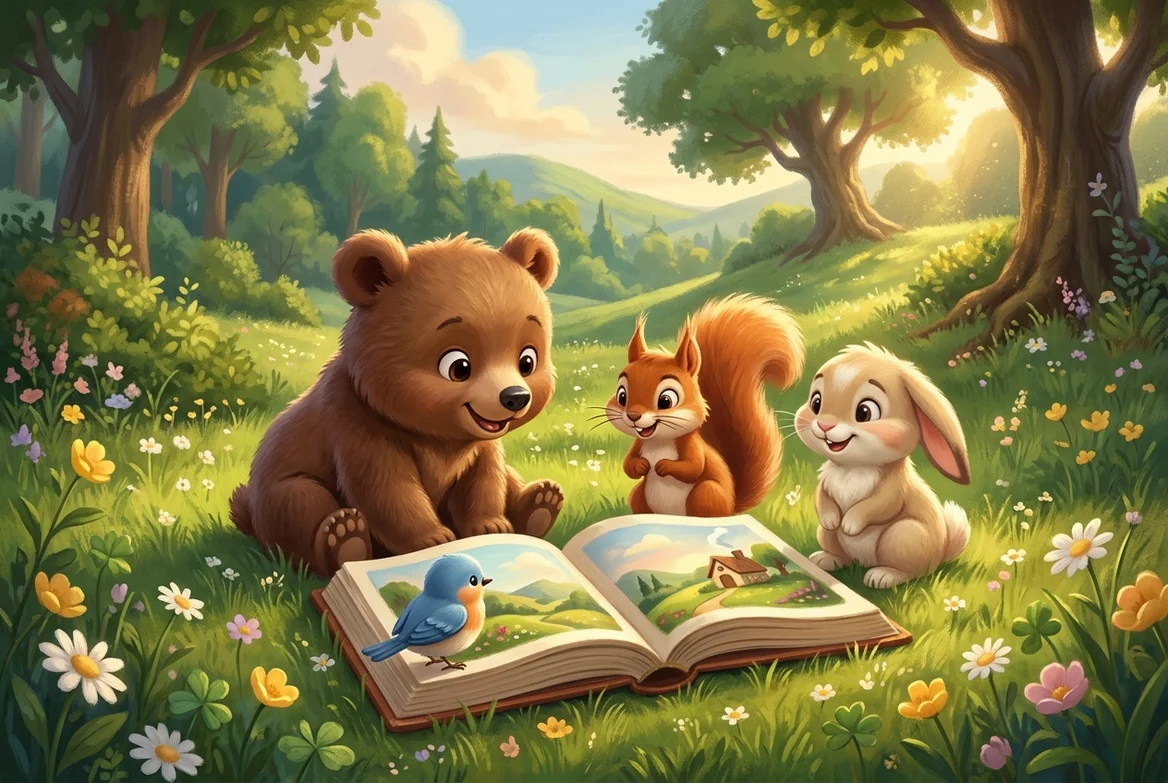
Animal stories for kids let children explore fear, courage and kindness through the eyes of a bird, a frog or a mouse. The eight free books below cover every stage from babies to age twelve, and each one can be read online, played with narration, or downloaded as a PDF.
Why animal characters work
Ask a child “Are you scared?” and you’ll often get silence. Ask “Why was Pip afraid to jump out of the nest?” and the answers come easily. An animal character puts a little distance between a child and a big feeling. They notice it in the bird first, then recognize it in themselves.
Animal stories also open a door to the real world. A child who has just read about a bee watches the bees in the garden differently. A story about street cats is a natural lead-in to talking about how to approach the cat down the block.
8 animal stories for every age
| Book | Age | Level | Pages | Time | Why this one |
|---|---|---|---|---|---|
| The Little Bee Gathers Flowers | 0-3 | A1.1 | 12 | 1 min 33 sec | Buzzing sounds and bright flowers |
| The Little Bird’s First Flight | 4-6 | A2.1 | 12 | 2 min 8 sec | A nervous bird finally leaves the nest |
| Pip and the Lake of Courage | 4-6 | A2.1 | 12 | 2 min 38 sec | A frog takes his first stroke |
| Hazel the Curious Squirrel | 4-6 | A2.1 | 10 | 1 min 33 sec | A squirrel starts a forest cleanup |
| The Forest Guardian and the Brave Mouse | 7-9 | A2.2 | 14 | 3 min 15 sec | The Lion and the Mouse, warmly retold |
| Lily and the Secret Path of the Street Cats | 4-6 | A2.1 | 10 | 3 min 12 sec | Helping street cats with a real plan |
| The Slow Turtle and the Fast Bird | 10-12 | B1 | 12 | 3 min 48 sec | Patience and speed reach the Sun Fruit |
| The Curious Squirrel and the Lost Acorn | 10-12 | B1 | 15 | 2 min 57 sec | Asking friends for help finds Pip |
There are more than 70 animal titles on the site. Browse the full animal stories shelf or the animals category.
Choosing by age
Ages 0-3: sounds and colors. In The Little Bee Gathers Flowers, Buzzy visits a red poppy, a yellow daisy and a blue flower, with a “Bzz!” on nearly every page. At this age, imitating sounds matters more than following a plot. Buzz together and point to each color.
Ages 4-6: first fears, first brave steps. In The Little Bird’s First Flight, Pip’s siblings have already flown away, but looking down makes him dizzy. In Pip and the Lake of Courage, a different Pip is nervous about deep water until his friends help him take his first stroke. Both stories treat fear as normal and show it shrinking one small step at a time. Hazel the Curious Squirrel finds a plastic bottle and a bag in the forest and starts a cleanup that the whole forest joins.
Ages 7-9: a classic lesson and a real responsibility. The Forest Guardian and the Brave Mouse is a warm retelling of The Lion and the Mouse. Proud Leo the lion laughs at tiny Squeaky’s promise to help him someday, then gets caught in a hunter’s net. Lily and the Secret Path of the Street Cats is realistic: Lily follows Caramel the cat to a neglected hidden garden and realizes that love alone isn’t enough; she needs a plan and some help.
Ages 10-12: teamwork and difference. In The Slow Turtle and the Fast Bird, patient Shelly and speedy Dash combine their strengths to reach a magical fruit. The Curious Squirrel and the Lost Acorn follows Nutty, who learns that asking friends for help makes a lost-acorn crisis much easier. Both are B1 level with richer language and more abstract messages.
Fable, talking-animal story, or realistic story?
Animal stories come in different flavors, and naming them builds comprehension. A fable is a short tale where animals act like people and the ending states a lesson; The Lion and the Mouse is one of the best-known, traditionally credited to Aesop. Ask, “What’s the lesson in one sentence?” A talking-animal story like The Little Bird’s First Flight focuses on a feeling rather than a moral. A realistic animal story like Lily and the Secret Path of the Street Cats has animals that don’t talk, which makes it the best kind for discussing how to treat real animals.
Connecting the story to real animals
The easiest way to make an animal story stick is to follow it with one small real-world step:
- After the bee story: Visit a park and look for bees on flowers. Talk about why we watch from a distance instead of touching.
- After Hazel the squirrel: Grab gloves and a bag and do a five-minute cleanup at a nearby playground.
- After the lion and the mouse: Ask, “Has someone smaller than you ever helped you?” Kids often think of a younger sibling or a classmate.
- After the street cats story: Talk about why leaving water near a neighborhood cat may be kinder than trying to pick it up.
These steps turn the lesson into something your child has actually done, which lasts much longer than a moral at the end of a page.
A 7-day animal story plan
- Day 1: The Little Bee Gathers Flowers (great with a younger sibling)
- Day 2: The Little Bird’s First Flight
- Day 3: Pip and the Lake of Courage
- Day 4: Hazel the Curious Squirrel, plus a mini cleanup
- Day 5: The Forest Guardian and the Brave Mouse
- Day 6: Lily and the Secret Path of the Street Cats
- Day 7: Draw your favorite animal from the week and tell one sentence about it
For older kids, add The Slow Turtle and the Fast Bird and The Curious Squirrel and the Lost Acorn. Animal pages in the coloring books make a nice follow-up.
Discussion questions
- What did Pip’s mom and dad say before his first flight? Who gives you courage?
- What helped the frog-hero of Courage Lake finally get into the water?
- Why did Leo the lion laugh at Squeaky? What did he learn after the net?
- Why did the cats hide when Lily came close? How did she end up helping them?
- Could Shelly or Dash have reached the fruit alone? Why not?
For more on building empathy through characters, see Empathy Glasses: how to teach children empathy through books.