A strong 3rd grade reading passage is a complete mini-story of a few hundred words paired with four or five comprehension questions. The seven free picture books below each run 10-12 pages; download the PDF, split each book into three short sections, and use the sample questions in this guide to turn them into ready-made passages.
Why real stories beat random passages
In third grade the focus shifts from “can my child read the words?” to “does my child understand what they read?” Many printable passages are short, unrelated paragraphs about facts. They work for drills, but kids rarely care what happens next. A passage cut from a real story has characters your child already knows from the previous section, so they want to find the answer. That motivation is half the battle.
Reading with a question in mind also builds a habit third graders need for the rest of school: going back into the text to find evidence instead of guessing.
7 stories that work as reading passages
| Book | Age | Level | Pages | Time | Why this one |
|---|---|---|---|---|---|
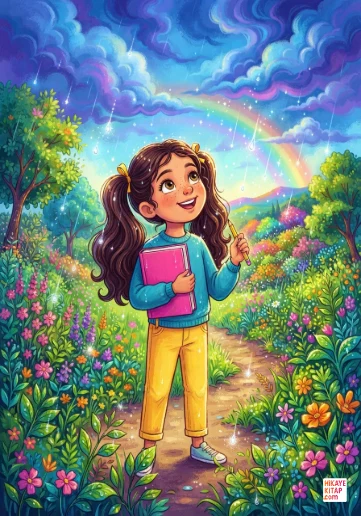
| Lily and the Little Rain Journal | 7-9 | A2.2 | 12 | 2 min 39 sec | A rain journal turns into a bar graph |
| Emily and the Talkative Crow’s Letter | 7-9 | A2.2 | 10 | 3 min 1 sec | A crow’s note leads to a watchmaker |
| The Secret of the Lighthouse | 7-9 | A2.2 | 10 | 2 min 42 sec | A beach key unlocks the lighthouse secret |
| Lily and the Sand City | 7-9 | A2.2 | 12 | 3 min 17 sec | Arguing ruins it, listening rebuilds it |
| Lily and the Little Forest Library | 7-9 | A2.2 | 12 | 3 min 19 sec | Building a book nook without harming trees |
| Leo and the Little Paper Plane Experiment | 7-9 | A2.2 | 11 | 2 min 54 sec | Fair testing three paper plane designs |
| Emma’s Big Adventure | 7-9 | A2.1 | 10 | 2 min 10 sec | An easy walk ending with a goodnight star |
All seven sit on the ages 7-9 shelf. For a wider list by grade, see free story books for 3rd graders.
How to turn a book into 3rd grade reading passages (PDF)
- Download. Click the PDF download button on the book page and print. Black and white is fine.
- Split. Divide a 12-page book into three passages: the beginning (the problem appears), the middle (the characters try something), the end (the resolution).
- Add four questions. Write them under each section, mixing the four types below.
- Self-check. After answering, your child plays the narration for that section and checks their own work.
Four question types, with real examples
Literal recall (the answer is in the text). For Emily and the Talkative Crow’s Letter: “What address was written on the paper Caw dropped?” The text states it plainly: Mr. Harrison, Watchmaker, 12 Lavender Lane.
Inference (reading between the lines). For Lily and the Sand City: “Why did the first sand city fall apart?” The story shows Mia insisting on a tower and Leo on a bridge, with everyone building in different places. Kids have to connect those clues.
Vocabulary in context. For Lily and the Little Rain Journal: “Lily turned her notes into a bar graph. What is a bar graph, and why might it help?” Let your child guess from the sentence before you explain.
Sequencing. For The Secret of the Lighthouse, ask your child to put these in order: the chest clicks open, Leo finds a key on the beach, the friends visit Captain Ben, the brass lens goes onto the lighthouse lamp.
Is the passage the right level?
A good passage should stretch your child a little, not wear them out.
- Just right: They finish the section with a few stumbles and answer three of four questions correctly, looking back at the text when needed.
- Too hard: They stop on nearly every line, or can’t locate even the literal answers. Play the narration first and hand over the questions the next day.
- Too easy: They answer everything instantly without looking back. Move on to a longer book such as Lily and the Little Forest Library.
If you want to watch fluency over time, try the reading speed test once a month. Treat the number as a rough guide; the same child reads at different speeds in different texts.
Keep it from feeling like homework
Let your child write one of the four questions: “Ask me a question about this part.” Switching roles makes them reread more carefully than any worksheet could. Not every answer has to be written; some days, talking it through is enough. Asking them to highlight the sentence that proves their answer turns the questions into a detective game. And if they’re tired, leave the last question for tomorrow rather than forcing it.
A 4-week reading passage plan
- Week 1: Lily and the Little Rain Journal, one section on Monday, Wednesday and Friday. On the weekend, keep a one-day weather note together.
- Week 2: Emily and the Talkative Crow’s Letter, then the easier Emma’s Big Adventure to end the week on a confident note.
- Week 3: The Secret of the Lighthouse and Lily and the Sand City, with extra focus on sequencing and inference.
- Week 4: Leo and the Little Paper Plane Experiment and Lily and the Little Forest Library. After the paper plane story, fold three different planes, launch them from the same line, and record the distances in a simple chart.
Log each finished passage on the reading log so your child can see a month of progress at a glance.
Discussion questions
- Why was Mr. Harrison so moved when he saw the old paper?
- How did Lily get her friends to work together on the second sand city? Would you have built the tower or the bridge first?
- The lighthouse friends didn’t find gold. Why was what they found more valuable to their town?
- Why did Leo insist on throwing the same plane three times before trusting the result?
- How did Lily, Leo and Maya build their forest library without hurting any trees?
A quick classroom idea
Turn one book into a jigsaw lesson: split the class into groups of three or four and give each group a different section of the same story. Each group reads its part, then explains it to the class, and together everyone puts the events in order. One 12-page book fills a full lesson. Find more printable titles on the free PDF children’s books page.