The best short stories for 2nd grade are 10 to 12 pages long, can be read in a single sitting, and tell one clear event with a satisfying ending. All eight picture books below are free to read online with narration, and each one has a PDF download button so you can print it for home or class.
What makes a story right for second graders
Second grade is the year many kids move from sounding out words to following a plot. A long chapter book can drain their energy before the story even gets going. A short book gives them the feeling of finishing something real, and that feeling is what makes them want to open another one tomorrow.
We picked these titles with three filters: 10-12 pages, a CEFR language level of A2.1-A2.2, and a situation a seven- or eight-year-old recognizes, such as the first day of school, a science project at home, or a mysterious note from a crow. Ages, levels, page counts and narration times come straight from each book’s page.
8 short stories for 2nd graders
| Book | Age | Level | Pages | Time | Why this one |
|---|---|---|---|---|---|
| Merve’s School Bag Countdown | 7-9 | A2.2 | 12 | 3 min 34 sec | “How many?” pattern builds quick fluency |
| Elara and the Little Bird | 7-9 | A2.1 | 10 | 1 min 34 sec | Rainbow feather and a tiny talking bird |
| Grace’s Colorful Magnifying Glass | 7-9 | A2.2 | 12 | 2 min 8 sec | Color words with a magic magnifying glass |
| Emily and the Tiny Windmill | 4-6 | A2.1 | 10 | 2 min 34 sec | Building a tiny model to catch wind |
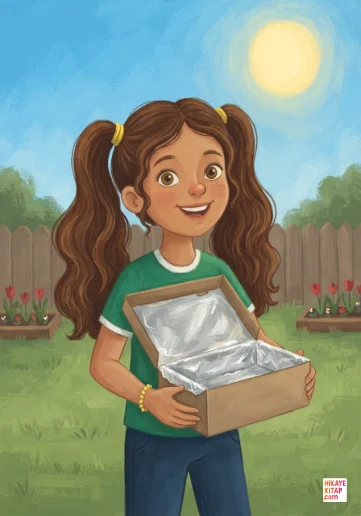
| Lily and the Little Solar Oven | 7-9 | A2.2 | 10 | 2 min 18 sec | Simple black-and-white paper heat test |
| Leo and the Cat that Counts the Stars | 7-9 | A2.2 | 12 | 2 min 16 sec | A silent white cat shares the stars |
| The Map of the Mysterious Castle | 7-9 | A2.2 | 10 | 2 min 19 sec | Grandpa’s attic map leads three friends |
| The Happy Story of the Different Duckling | 7-9 | A2.2 | 10 | 2 min 38 sec | A gray duckling grows through four seasons |
For more titles in the same range, browse the ages 7-9 shelf or our grade-level guide to free story books for 2nd graders.
Matching the story to the reader
The hesitant reader. Start with Merve’s School Bag Countdown. Every page repeats the same question, “How many?”, followed by a number and an object: five notebooks, eight erasers, and so on. That predictable pattern lets a hesitant reader feel fluent fast. Have them tap each item on the page while counting.
The dreamer. Elara and the Little Bird is one of the shortest texts here. A rainbow feather, a tiny talking bird, and the line “you can turn every day into an adventure with your imagination” make a great prompt for a drawing afterward.
The tinkerer. Lily and the Little Solar Oven follows a simple science arc: a question, a test with Ms. Clara, and a result. Lily and her teacher put black and white paper in the sun and find the black one gets much hotter. You can repeat that test on a sunny windowsill in five minutes.
The reader who is ready for a bit more. The Happy Story of the Different Duckling covers a full year in ten pages, from hatching through winter to spring. Because it echoes a tale many kids already know, it is a confidence-builder before moving to longer books.
Using short stories for 2nd grade as a PDF and with narration
The real power of a short story is that you can read it several ways without it getting stale. Here is a routine that works well:
- Listen. Open the book page and play the narration while your child looks at the pictures.
- Echo read. You read a sentence, your child reads it back.
- Read solo. Hit the PDF download button, print it, and let your child read alone with a pencil to underline any word that slowed them down.
- Retell. Close the book and ask for the story in three sentences.
You don’t have to do all four steps in one evening. Listening and echo reading on Monday, solo reading and retelling on Tuesday, is a calm pace.
Signs the story is too hard or too easy
If your child stumbles on three or four words per page, loses their place, or can’t tell you anything about the plot afterward, keep using narration with that book for another week. If they breeze through and look bored, move up to books with narration over three minutes. Our reading speed test gives a rough idea of pace, but results vary from child to child and from text to text, so treat it as a conversation starter, not a score.
A 7-day short story plan
- Day 1: Merve’s School Bag Countdown. Count the supplies out loud together.
- Day 2: Grace’s Colorful Magnifying Glass. Go on a color hunt around the house.
- Day 3: Elara and the Little Bird. Draw the rainbow feather.
- Day 4: Lily and the Little Solar Oven. Try the black-and-white paper test.
- Day 5: Leo and the Cat that Counts the Stars. Look out the window at the night sky before bed.
- Day 6: The Map of the Mysterious Castle. Draw a treasure map of your living room.
- Day 7: Reread the week’s favorite from the printed PDF, solo.
Mark each finished book on the free reading log so your child sees the week add up.
Discussion questions
- What did Merve count in her backpack? What did Pamuk the cat bat with his paw?
- When Grace pointed her magnifying glass at the sky, what color did she name?
- Which paper got hotter in Lily’s test, the black one or the white one? Why do you think so?
- What did Leo, Lily and Max actually find in the castle instead of gold?
- Why did Mavi feel lonely, and what changed by spring?
Using short stories in the classroom
For teachers, a quick routine is to project the book with narration, then hand out printed PDFs to reading partners. One partner reads a page while the other listens and answers “who, where, what happened,” then they switch. Ten minutes a day gives steady fluency and listening practice. You’ll find more printable titles on the free PDF children’s books page, and matching coloring books make a nice early-finisher activity.