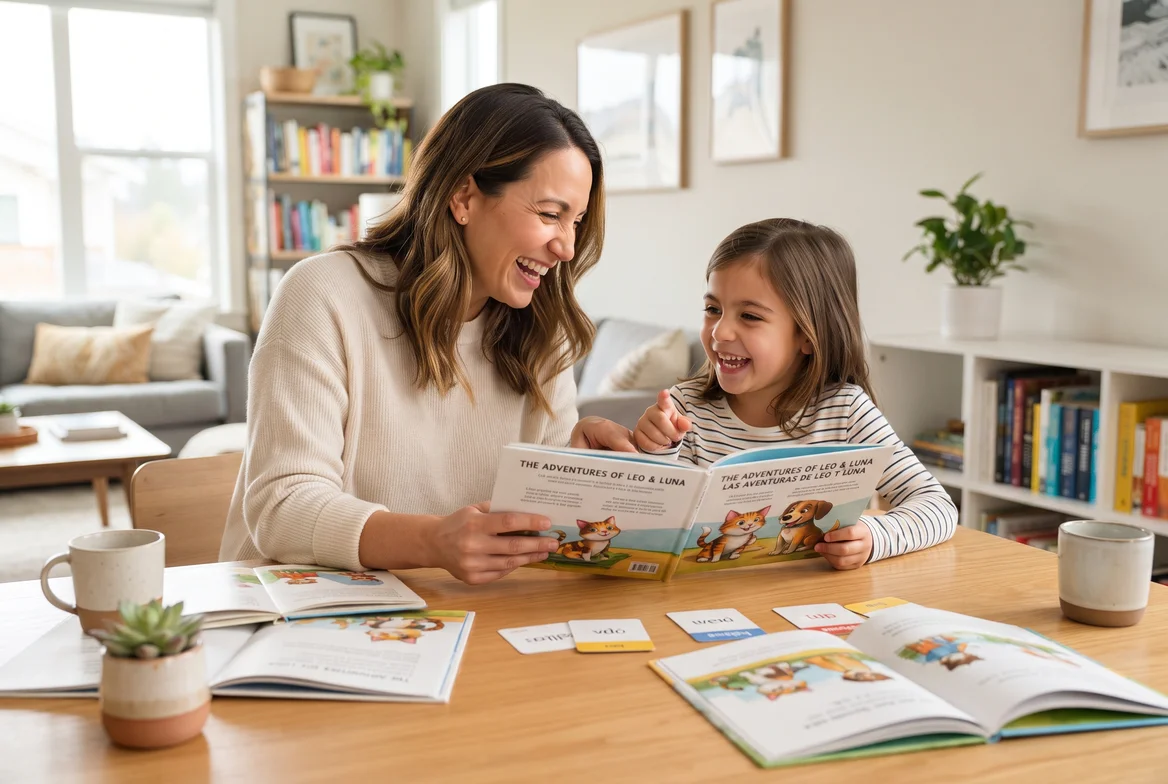
Short answer: If you are raising bilingual children with Turkish and English, every book in our library has both a Turkish and an English version. You can read, listen to, or download as a free PDF picture books for ages 0-9 in either language, with narration from about half a minute to just over 3 minutes, and switch languages on the same book with one click.
This guide is written for English-speaking families with a Turkish connection: a Turkish-speaking parent or grandparent, a family living abroad, or parents who simply want their child to hear Turkish. Its angle is keeping Turkish alive when English is the stronger language, even if you don’t speak Turkish yourself. The method is simple: read the same story in both languages, building meaning in the stronger one first and then hearing the other over the same pictures.
Why the Same Story in Two Languages?
Once a child knows a story in one language, the plot and pictures act as a map for the second. They don’t need to translate word by word; because they already know the rabbit is hunting for carrots, they pick up the Turkish word havuç from the picture and the context.
Many parents also wonder about children mixing both languages in one sentence. In the language development field, this “code-switching” is widely seen as common and usually normal in bilingual children. If you have a concern such as a speech delay or trouble understanding, the right people to talk to are your pediatrician or a speech-language pathologist.
10 Books You Can Read in Both Languages
Each book below has an English and a Turkish version. To switch, open the English book page and choose Türkçe in the language menu at the top; you’ll land on the same book in Turkish. The list moves from first-word books for the youngest to short stories for school-age children.
| Book | Age | Level | Pages | Time | Turkish edition |
|---|---|---|---|---|---|
| Cute Animal Sounds | 0-3 | A1.1 | 7 | 33 sec | Sevimli Hayvan Sesleri |
| World of Colors | 0-3 | A1.1 | 12 | 48 sec | Renkler Dünyası |
| What Am I Wearing Today? | 0-3 | A1.1 | 12 | 1 min 4 sec | Bugün Ne Giyiyorum? |
| I’m Tasting Fruits | 0-3 | A1.1 | 12 | 1 min 11 sec | Meyveleri Tadıyorum |
| Princess Lily and the Frog Prince | 4-6 | A2.1 | 12 | 2 min 17 sec | Prenses Lale ve Kurbağa Arkadaşı |
| The Little Rabbit and the Lost Carrots | 4-6 | A2.1 | 14 | 2 min 25 sec | Küçük Tavşan ve Kayıp Havuçlar |
| Ada’s Number Adventure | 4-6 | A2.1 | 12 | 2 min 33 sec | Ada’nın Sayı Macerası |
| Barnaby the Little Bear and the Forest’s Tiny Postman | 4-6 | A2.1 | 12 | 3 min 8 sec | Minik Ayı Badem ve Ormanın Küçük Postacısı |
| Grace’s Colorful Magnifying Glass | 7-9 | A2.2 | 12 | 2 min 8 sec | Gaye’nin Renkli Büyüteci |
| Ellie and the English Adventure of Colors | 7-9 | A2.2 | 12 | 3 min 15 sec | Ece ve Renklerin İngilizce Macerası |
Times are for the English narration; the Turkish versions differ by a few seconds. The last two books are especially handy: their Turkish editions weave English color words into the Turkish text, so both languages already meet on the same page.
How to Do Parallel Reading at Home
- Day 1, stronger language: Read or listen to the story in the language your child is most comfortable in, usually English for families abroad. Talk about the pictures: “What is the rabbit looking for?”
- Day 2, other language: Open the Turkish version of the same book and play the narration. Because your child knows the story, they follow the meaning through the pictures.
- Day 3, play: Pick three words from the book (for example tavşan, havuç, arkadaş: rabbit, carrot, friend) and find those things around the house or at the park, naming each one in both languages.
A few practical principles:
- No translation tests: Instead of asking “What’s that in Turkish?”, say it yourself and let your child repeat it if they want to.
- Short and regular: 5-10 minutes a day works better than one hour a week.
- One parent, one language (OPOL): Some families have each parent speak consistently in one language with the child. You can carry this into reading time: the Turkish-speaking parent (or the narration) handles the Turkish version, the other parent the English one.
- Age-appropriate expectations: At 0-3 the goal is hearing words; at 4-6, catching repeated phrases; at 7-9, trying to read short sentences alone.
If You Don’t Speak Turkish
Many families have one parent who speaks Turkish and one who doesn’t, or grandparents far away. The narration solves the pronunciation problem: let it read the Turkish while you sit beside your child, point at the pictures, and react in English. Children notice when a parent is curious about their other language, and learning a few words together can become a shared game rather than a lesson.
When your child is ready to read Turkish themselves, print the Turkish PDF. Turkish spelling is very regular, so once they learn the six letters English doesn’t have (ç, ğ, ı, ö, ş, ü), much of the text becomes readable. Circling those letters on the printout is a simple first exercise.
A 4-Week Bilingual Reading Plan
Two books a week, each using the three-day cycle above. Day 7 is free rereading.
| Week | Ages 0-3 | Ages 4-9 |
|---|---|---|
| 1 | Cute Animal Sounds, World of Colors | Ada’s Number Adventure, Grace’s Colorful Magnifying Glass |
| 2 | I’m Tasting Fruits, What Am I Wearing Today? | The Little Rabbit and the Lost Carrots, Ellie and the English Adventure of Colors |
| 3 | World of Colors and Cute Animal Sounds (repeat) | Princess Lily and the Frog Prince |
| 4 | The week’s favorite, in both languages | Barnaby the Little Bear and the Forest’s Tiny Postman |
Record books on the reading log; writing English titles in one color and Turkish titles in another shows your child their progress in both languages. When the log is full, print the certificate.
How to Download the PDF
- Click a title in the table to open the English book page.
- Press Download PDF; switch to Türkçe at the top of the page and use the PDF button there for the Turkish file.
- Print both on A4 or letter paper and lay matching pages side by side.
For word practice, each book page can also turn its illustrations into coloring pages, and there are more in the coloring books section: naming colors in both languages while coloring is an easy game. All files are in the free PDF children’s books library, and the mobile app works for reading on a phone.
Questions to Ask After Reading
- Ada’s Number Adventure: What did Ada count from one to ten? Let’s count to ten at home, once in English and once in Turkish (bir, iki, üç…).
- What Am I Wearing Today?: What do we wear when it rains? What’s the weather like today, and can we say it in both languages?
- The Little Rabbit and the Lost Carrots: Who helped Pip look for the three lost carrots? When you hear the Turkish version, wave when you hear havuç.
- Grace’s Colorful Magnifying Glass: What colors did Grace find with her magnifying glass? In Turkish she’s called Gaye. Why do you think her name changed?
Related Pages
Find more books by age on the ages 0-3, ages 4-6, and ages 7-9 pages. For read-aloud routines with the youngest, see story books for ages 0-3: a guide for parents.








