Lily and the Little Protectors of the World
During the first week of school, Lily saw a colorful poster hanging on the bulletin board in the hallway: Environment...
12 pages · 3 min
Type into the box above to start searching
Features and shortcuts to enhance your reading experience


To Mia, the sky was like the world’s biggest, most mysterious diary. Every morning, she woke up early to watch the shapes of the clouds and see how brightly the sun was shining. She watched the weather reporters on TV with wonder, trying to guess which way the wind would blow before they even said it. For Mia, the weather wasn’t just news; it was an exciting adventure that changed every single day.

One day at school, she had a brilliant idea. During science class, she went to Mrs. Gable with excitement. “Mrs. Gable, instead of just watching the weather on TV, why don't we track it right here at school? We could set up a small weather station in the garden!” Mrs. Gable loved Mia’s bright idea. She smiled over her glasses and promised to help her make it happen.

The project began right away! Mia and her best friend, Leo, chose the sunniest corner of the school garden. They set up a thermometer, a colorful wind vane to show the wind's direction, and a clear jar to measure the rain. Leo fixed the wind vane to the fence while Mia made sure the thermometer was standing straight. Now, they had their very own weather station!

To get the right results, they had to be very disciplined. Mia and Leo decided to meet at the station every day during lunch break, exactly at 12:00. Mia would read the temperature, and Leo would write down which way the wind was blowing. Checking their watches and taking measurements without missing a single day made them feel like real scientists.
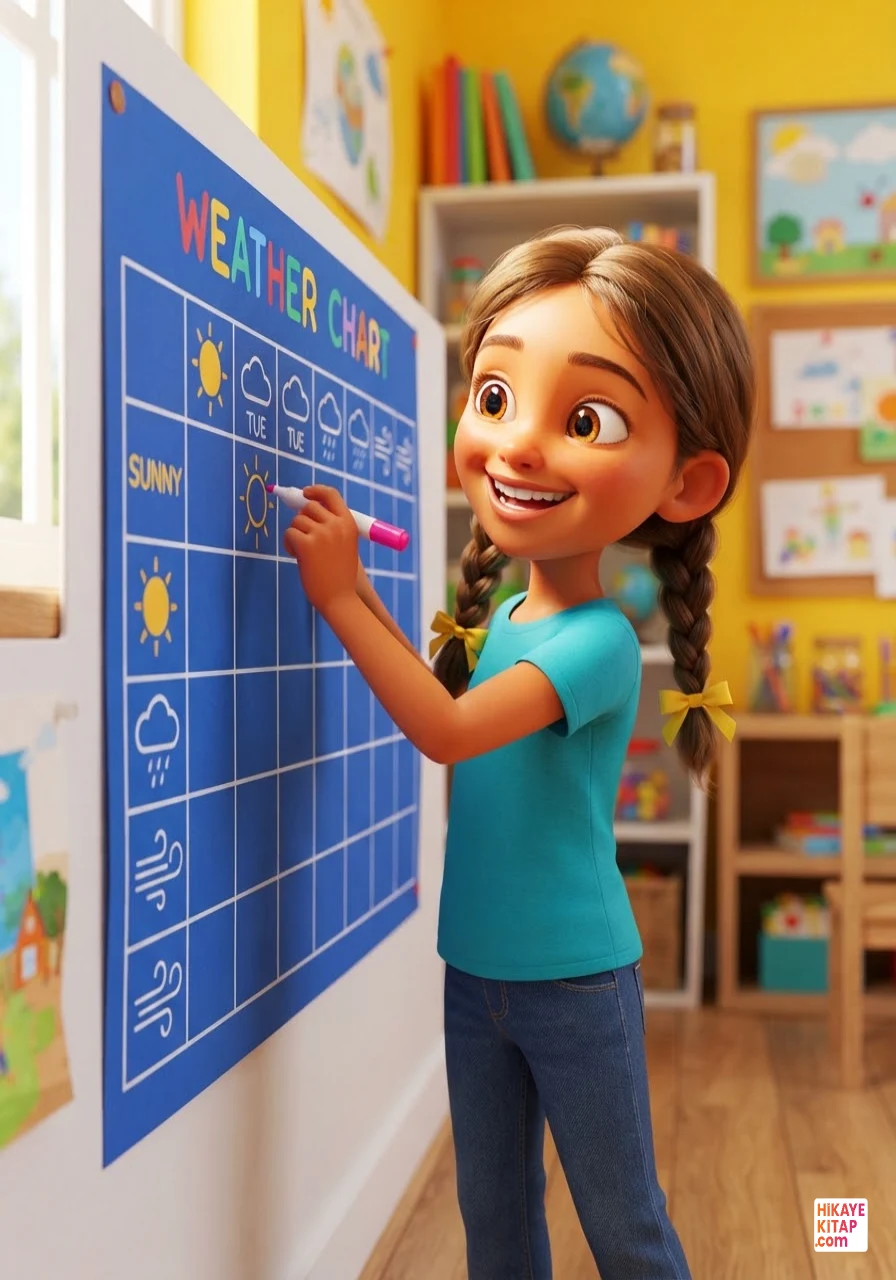
Mia began writing all the information they collected on a giant, rainbow-colored chart she hung on the classroom wall. Monday was sunny, Tuesday was windy, and Wednesday was partly cloudy. She colored each box differently and wrote the temperature values in big, bold numbers. As the chart filled up, the secret language of the sky began to come alive on the paper.

After one week, Mia and Leo studied the chart. “Look, Leo,” Mia said, “the temperature isn't the same every day! Yesterday was very hot, but today is much cooler.” Leo nodded in surprise. They realized that they couldn't fully understand how much the weather changed just by looking outside; they had to measure it to see the truth.

One morning, the sky turned gray with heavy clouds, and a loud rain began to fall. Mia immediately put on her bright yellow raincoat and ran outside. She was curious to see how much the rain jar had filled up. She noticed something amazing: when the rain started, the temperature on the thermometer dropped quickly. The rain didn't just get things wet; it made the air cooler too!

Mrs. Gable came over to look at the chart. “You’ve done a wonderful job, children,” she said. “However, to truly understand nature, one week is not enough. If you keep taking measurements for a longer time, you can understand the rhythm of the weather and how the seasons change. Patience is the greatest key to science.”

Following her teacher’s advice, Mia decided to keep the project going for a whole month. She and Leo flew kites on windy days and rested in the shade on sunny days, but they never missed their measurements. By the end of the month, they had a magnificent weather archive. They had become the neighborhood’s little meteorologists.

Mia no longer just learned about the weather from the TV; she followed the world through her own observations. The little weather station they built became the most loved part of the school’s Science Corner. Mia smiled every morning when she looked at the sky, because she now knew exactly what the clouds and the wind were telling her.
During the first week of school, Lily saw a colorful poster hanging on the bulletin board in the hallway: Environment...
Leo had come up with a brilliant idea for his classroom. He placed a bright orange shoebox on his desk and began to p...
It was a warm summer evening. Chloe spread a soft, bright orange blanket over the fresh green grass in the garden. Th...
Use the link and iframe code below to embed the book on your site.