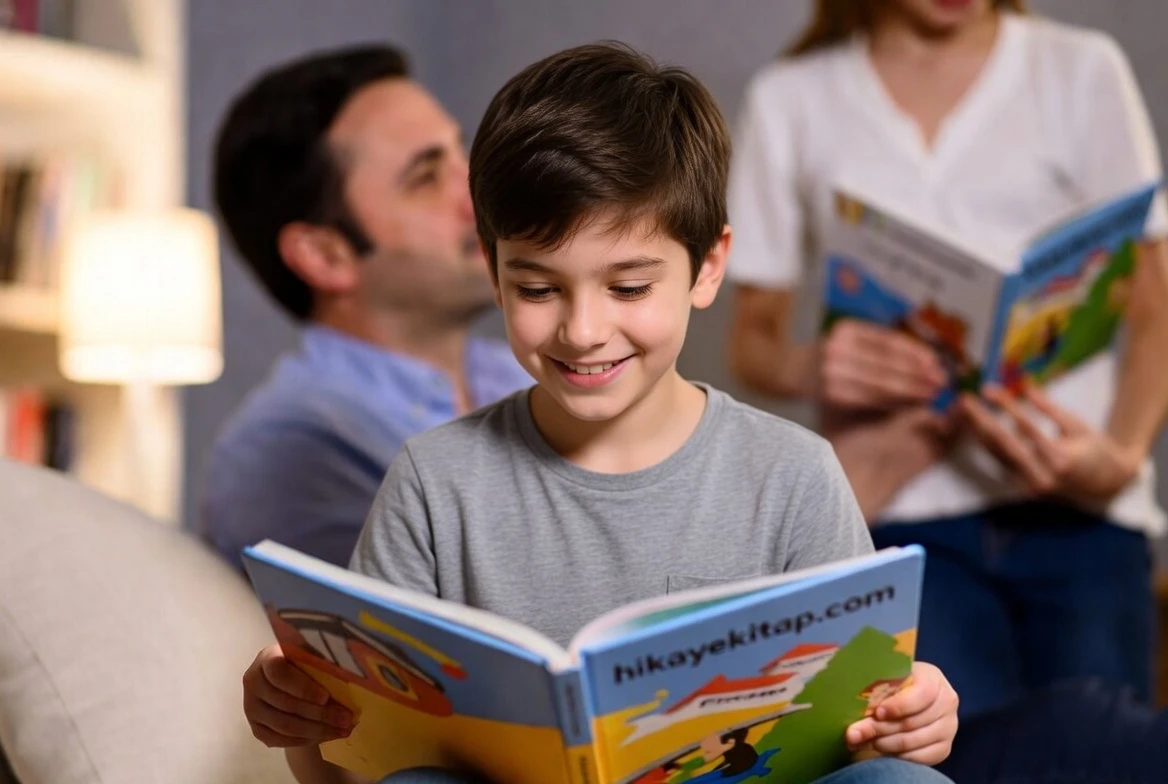
Free story books for 6th graders on our site are short, B1-level illustrated stories: 11–15 pages, about 3–7 minutes of narration, covering mysteries, science projects and adventures inspired by classics. Each can be read online, listened to with audio narration, or downloaded as a free PDF, and works best as skill practice alongside full-length novels.
Let’s be upfront about fit. A typical 6th grader reads chapter books and novels, and our stories are much shorter than that. Where they shine is as focused practice: a complete story your student can read in one sitting and then use to practice a specific reading skill, plus solid support for English learners and kids who need a confidence boost. Further down you’ll find well-known novels to pair them with.
What Reading Looks Like in 6th Grade
Sixth grade is usually the first year of middle school, and reading expectations shift. Instead of mainly retelling what happened, students are asked to:
- Cite evidence: point to the exact sentence that supports an answer.
- Find the theme: say what a story is really about beyond the plot.
- Follow character change: explain how a character responds to a problem and grows.
- Notice point of view: recognize who is telling the story and how that shapes it.
A short story is an efficient way to practice these, because the whole text fits on a few pages and you can go back to it easily.
Short Stories for Grade 6 Skill Practice
| Book | Age | Level | Pages | Time |
|---|---|---|---|---|
| The Laboratory of Invisible Numbers | 10-12 | B1 | 12 | 2 min 39 sec |
| The Secret of the Blue Horizon: A Journey to the Heart of the Ocean | 10-12 | B1 | 12 | 3 min 28 sec |
| The Door to the Snow Realm: The Wise Lion, the Witch and the Wardrobe | 10-12 | B1 | 15 | 4 min 9 sec |
| Leo and the Light of Conscience | 10-12 | B1 | 12 | 4 min 30 sec |
| The Cartographer of the Misty Bay | 10-12 | B1 | 12 | 5 min 13 sec |
| The Brave Heart of Sherwood Forest | 10-12 | B1 | 15 | 5 min 18 sec |
| The Energy Detectives Club | 10-12 | B1 | 12 | 5 min 25 sec |
| Letters from the Lost Valley | 10-12 | B1 | 11 | 5 min 38 sec |
| The Last Station of the Railway | 10-12 | B1 | 11 | 6 min 8 sec |
| The Color Experiment in the Time Garden | 10-12 | B1 | 12 | 6 min 31 sec |
| The Wind Workshop on the Northern Slopes | 10-12 | B1 | 12 | 7 min 19 sec |
The table runs roughly from shortest to longest. The Energy Detectives Club and The Color Experiment in the Time Garden follow students using real observation and data, so they pair nicely with science class. Leo and the Light of Conscience is the strongest pick for theme discussions, and the two classics-inspired titles, The Door to the Snow Realm and The Brave Heart of Sherwood Forest, make an easy bridge to the full novels they echo.
Using Narration and PDF Together
A routine that works for both homework and class:
- Listen first. Play the narration while the student follows the text. This is especially helpful for English learners, who hear pronunciation and phrasing in context.
- Read and mark. Print the PDF and have the student read it again alone, underlining one sentence that shows how the main character feels and one that hints at the theme.
- Answer with evidence. Ask one question and require a quote from the page in the answer. Because the story is short, finding the quote takes minutes, not an evening.
To check whether a full novel is the right level, use the five-finger rule: if your student hits five unknown words on a single page, that novel is better as a read-aloud or audiobook for now. Our short stories can fill the gap while they build up to it.
Novels to Pair With the Short Stories
These are widely read in grade 6 classrooms and easy to find at libraries. They’re not on our site, and we don’t offer PDFs of them.
- Wonder by R.J. Palacio: kindness and point of view, told by several narrators.
- Hatchet by Gary Paulsen: survival and problem-solving.
- Holes by Louis Sachar: a mystery with interlocking timelines.
- Bridge to Terabithia by Katherine Paterson: friendship and loss.
- A Wrinkle in Time by Madeleine L’Engle: science fiction and courage.
- Number the Stars by Lois Lowry: historical fiction set in WWII Denmark.
- The Phantom Tollbooth by Norton Juster: wordplay and imagination.
- The Lion, the Witch and the Wardrobe by C.S. Lewis: a natural next step after The Door to the Snow Realm.
A 4-Week Skills Plan
Each week focuses on one 6th-grade skill. Aim for 20–30 minutes a day: a short story on two or three days, the rest on a novel.
| Week | Skill focus | Short stories | Novel task |
|---|---|---|---|
| 1 | Citing evidence | The Laboratory of Invisible Numbers, The Energy Detectives Club | Pick a novel; find one quote that shows the main character’s problem |
| 2 | Character change | Leo and the Light of Conscience, The Cartographer of the Misty Bay | Note how the main character has changed by the middle |
| 3 | Theme | The Door to the Snow Realm, The Brave Heart of Sherwood Forest | Write one sentence on what the novel is “really about” |
| 4 | Point of view | Letters from the Lost Valley, The Color Experiment in the Time Garden | Retell one scene from another character’s view |
Students can track what they read in our printable reading log; with a free account, reading history and badges are saved automatically.
How to Download the PDF
- Click a book title to open its book page.
- Use the PDF download button on that page.
- Print on A4, single-sided, so the back can be used for notes and evidence quotes.
Our coloring pages are aimed at younger kids but can be handy for siblings.
Discussion Questions
- The Energy Detectives Club: What evidence did Kaan, Defne, Kerem and Maya collect about energy waste at school? Which small action would make the biggest difference at your school?
- Leo and the Light of Conscience: The compass seemed to point to the right choice. Was it the compass guiding Leo, or something else?
- The Color Experiment in the Time Garden: How did the friends test the effect of light color on plants? What would make the experiment more fair?
- The Laboratory of Invisible Numbers: Which puzzle or code in the lab would you have solved first, and how?
- The Door to the Snow Realm: The story says even the darkest winter can end with courage and friendship. Which moment shows that best?
More Reading by Grade
See every story for this age on our ages 10-12 page, or browse all printable files in the free PDF children’s books library. For the grades on either side, read our guides to story books for 5th graders and story books for 7th graders.








