Book stories that instill reading habits in children are short enough to finish in one sitting and good enough that a child asks for another. This guide lists 10 such stories for ages 4-12 (about 1.5 to 4.5 minutes each) and matches each one to a daily reading moment. Every story can be read online, listened to with narration, or downloaded as a free PDF.
The angle here is when to read, not only what. Habits stick when they are tied to a moment that already exists in your day. We use three anchors: the after-school slot, a slower weekend morning, and bedtime. For more general strategies, see our guide to free digital children’s books that build reading habits.
10 Stories, Sorted by Reading Moment
| Book | Age | Level | Pages | Time |
|---|---|---|---|---|
| Zippy’s Giant Carrot | 4-6 | A2.1 | 10 | 1 min 23 sec |
| Ela the Swallow and Minik the Ant | 4-6 | A2.1 | 12 | 1 min 40 sec |
| Arda and Ulcan the Curious Wolf | 4-6 | A2.1 | 12 | 1 min 49 sec |
| The Wise Crow and the Cunning Fox | 4-6 | A2.1 | 12 | 2 min 17 sec |
| The Little Rabbit and the Lost Carrots | 4-6 | A2.1 | 14 | 2 min 25 sec |
| The Map of the Mysterious Castle | 7-9 | A2.2 | 10 | 2 min 19 sec |
| The Dragon and the Brave Boy | 7-9 | A2.2 | 10 | 2 min 33 sec |
| Eren and the Bright Lamp | 7-9 | A2.2 | 14 | 2 min 55 sec |
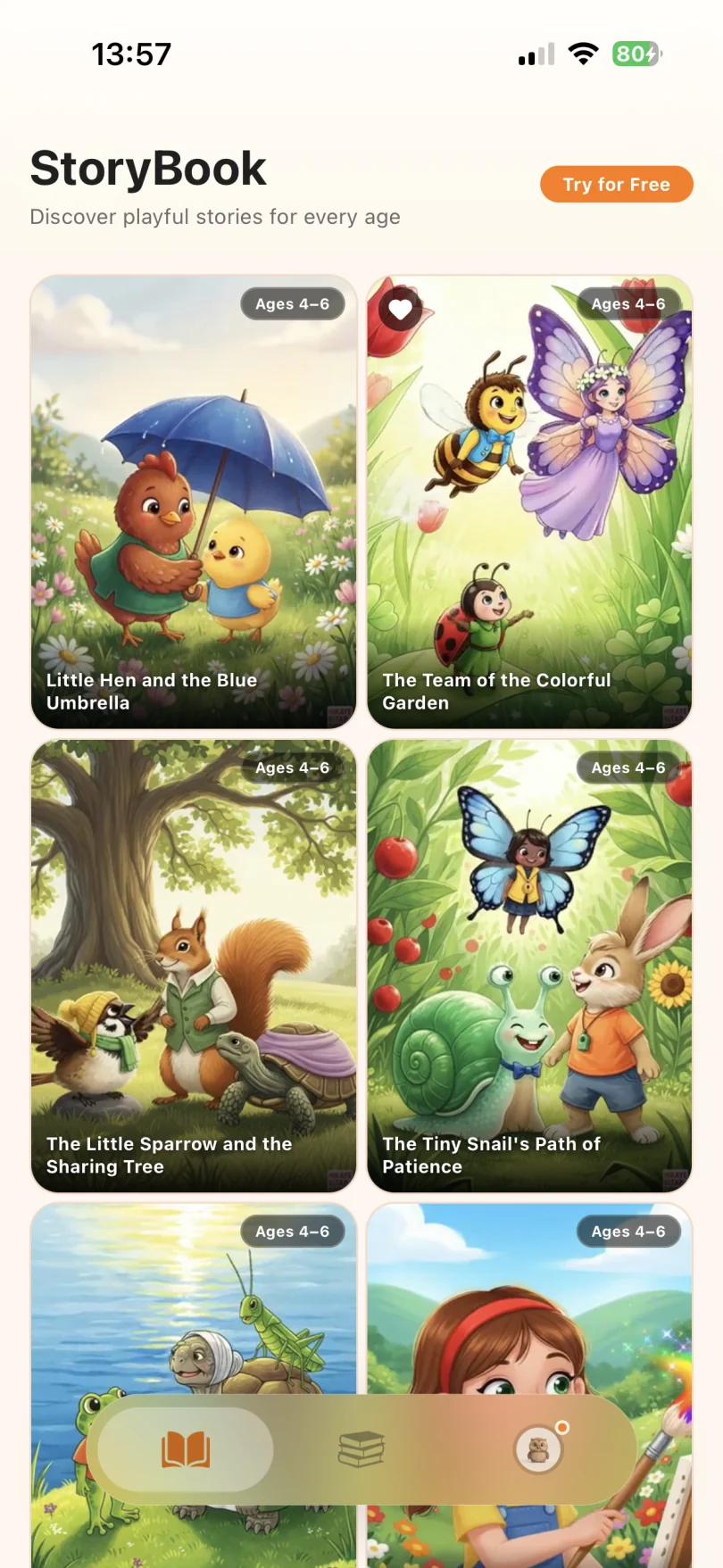
| The Tiny Snail’s Path of Patience | 4-6 | A2.1 | 15 | 4 min 36 sec |
| Leo and the Light of Conscience | 10-12 | B1 | 12 | 4 min 30 sec |
Anchor 1: The After-School Slot (Quick Wins)
Right after school, children are tired and want something easy. This is the place for the shortest stories, the ones under two and a half minutes: Zippy’s Giant Carrot, Ela the Swallow and Minik the Ant, Arda and Ulcan the Curious Wolf, and The Map of the Mysterious Castle. The goal is a quick “I finished a book” feeling, not a long session.
How to run it: put the snack on the table, open one story, and let your child choose whether to read it or press play on the narration. Five minutes, then done. Stopping while it is still fun is what makes them willing to do it again tomorrow.
Anchor 2: The Weekend Morning (Stories With a Problem to Solve)
Weekend mornings are slower, which suits stories with a puzzle or a choice: The Little Rabbit and the Lost Carrots (where did they go?), The Wise Crow and the Cunning Fox (who is smarter, and who is honest?), The Dragon and the Brave Boy (is the dragon really dangerous?), and for older readers Leo and the Light of Conscience.
How to run it: read the story once, then print the PDF and read it again, this time with your child pointing out the moment the problem changes. For children aged 7 and up, have them read one page aloud on their own and use the five-finger rule: one finger for every word they do not know. Four or five fingers means that story stays a listen-together book for now.
Anchor 3: Bedtime (Calm, Gentle Endings)
At bedtime, choose stories with a quiet ending and a warm message: Eren and the Bright Lamp and The Tiny Snail’s Path of Patience both slow the pace down. Narration helps here, because a steady voice does part of the settling for you; lower the volume and dim the screen.
How to run it: let your child pick the bedtime story from two options, never ten. A small choice gives ownership without turning bedtime into a long negotiation.
How Long, How Often
- Ages 4-6: about 10 minutes a day, mostly listening or reading together.
- Ages 7-9: about 15 minutes, with the child reading at least one story aloud each day.
- Ages 10-12: about 20 minutes, mostly independent reading.
Missing a day is fine. Missing a week is where habits break, so if life gets busy, shrink the session to one short story instead of skipping it.
Using narration and PDF together: listening first and reading second is the most reliable way to help a hesitant reader. On day one, play the narration while your child follows the text. On day two, give them the printed PDF of the same story to read aloud. A story they already know feels easy, and easy is what builds confidence.
A 4-Week Habit Plan
| Week | After school | Weekend morning | Bedtime |
|---|---|---|---|
| Week 1 | Zippy’s Giant Carrot, Ela the Swallow and Minik the Ant | The Little Rabbit and the Lost Carrots | Eren and the Bright Lamp |
| Week 2 | Arda and Ulcan the Curious Wolf | The Wise Crow and the Cunning Fox | The Tiny Snail’s Path of Patience |
| Week 3 | The Map of the Mysterious Castle | The Dragon and the Brave Boy | Child’s choice from weeks 1-2 |
| Week 4 | Child’s choice from the list | Leo and the Light of Conscience (ages 10-12) or a reread | Child’s choice |
Repeating a story is not a step backward; rereading is part of how habits form. Log every story, including rereads, on our printable reading log, and print the certificate at the end of the month. If you sign in, the site also keeps a reading history and awards badges.
How to Download the PDF
- Click a title in the table to open its book page.
- Press Download PDF.
- Print on A4 paper and keep the stories in a folder your child can reach.
For quiet afternoons, the same stories are available as black-and-white pages in our coloring books section.
Questions to Talk About
- Zippy’s Giant Carrot: Why did the carrot taste better once Zippy shared it? What is something you like sharing?
- The Wise Crow and the Cunning Fox: Prudence the crow and Finn the fox both learn a lesson. Which one learned something about honesty?
- The Little Rabbit and the Lost Carrots: How did Pip’s friends help him find his three carrots? Who helps you when you lose something?
- The Dragon and the Brave Boy: Arda found out Emerald the dragon was misunderstood. Have you ever been wrong about someone at first?
- The Tiny Snail’s Path of Patience: What did Calm notice in the forest that his fast friends missed? What could you notice on your walk home if you slowed down?
Keep Going
Find more stories for each age in our ages 4-6, ages 7-9, and ages 10-12 collections, or browse the full free PDF children’s books library. Choosing well also helps habits last; our guide on how to choose a children’s story book walks through what to look for.